

 Cartoon Studies on Twitter
 Cartoon Studies on Flickr
 Get the latest news
The first day of the International Comic Arts Forum conference, September 29th, featured a roundtable discussion on the various challenges and considerations facing an educator when trying to introduce comics into the classroom. The afternoon panel was moderated by Associate Professor Qiana Whitted of the University of South Carolina, and was comprised– from left to right– of James Sturm (Co-Founder and Director, CCS), Frank Bramlett (Associate Professor of English, University of Nebraska), Jen Vaughn (Librarian, blogger, and alumna, CCS), Jason Lutes (Professor, CCS), and Mark McKinney (Professor of French, Miami University – Ohio). While only three institutions of higher education were represented– four if you include the moderator– each participant addressed such different concerns and aspects of incorporating comics into curricula that the result was a wide-ranging survey from a diverse set of perspectives.
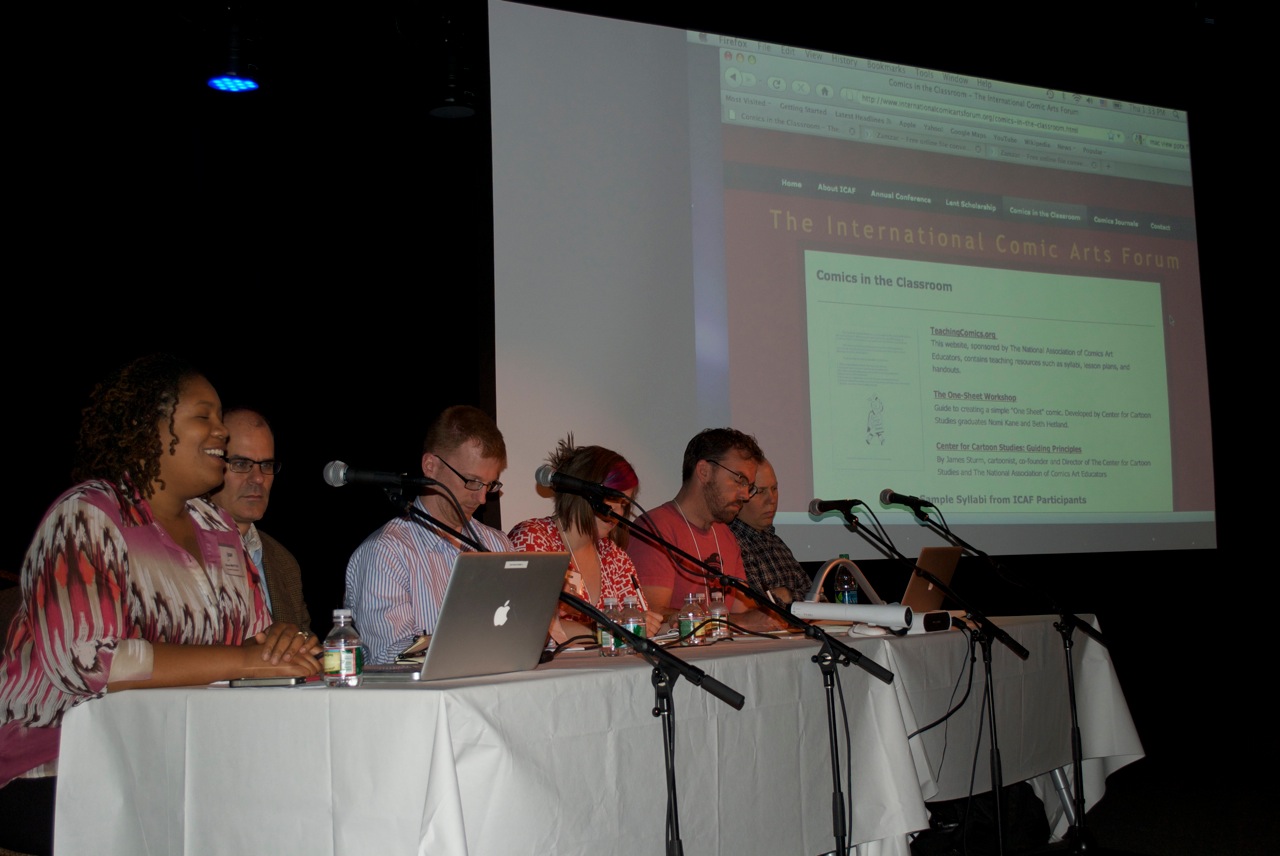 Roundtablers tough and able– quite indefatigable
How diverse? From single-day comics-making workshops with kids to multi-year postgrad comics-making programs with adults to learning French at an undergraduate level via bande dessinee to dissecting the linguistic and rhetorical tools at work in one’s favorite words-and-pictures monthly. Yowza. (Perhaps I should’ve titled this post “Pow! Zap! Comics Aren’t Just for Comics Fans Anymore.”) It underscored how multidisciplinary the medium is, and thus how confused or uncomfortable outsiders and administrators might be at its inclusion in a non-arts program.
That said, I feel that such moderate and multi-tiered academic interest in the art form speaks well of its absorption into the everyday mainstream of our culture, and so had been looking forward to attending this 1.5-hour panel beyond seeing the familiar faces.
Ms. Whitted introduced the panelists and mentioned “comics in the classroom” resources emerging online, such as CCS affiliate teachingcomics.org. A handy clearinghouse page on the topic– seen in the background above!– has been added to the ICAF website here; it includes PDFs of course syllabi from Whitted, McKinney, Charles Hatfield, and others, and is worth a gander. Each panelist then gave a brief overview of their own experience with comics in the classroom: McKinney assigns Francophone books like Tintin, Epileptic, and Persepolis to his students, and they discuss the medium’s interdisciplinary nature and its theory and practice alongside learning a language; he’s tailored the reading choices to fit within preexisting class requirements for his department and has found great support from the university, which was heartening to hear. Lutes teaches the craft and theory of comics to both CCS classes at any given time– via Foundation Studio and Senior Seminar– and uses two points of inspiration to help guide his curriculum: His own experience in art school at RISD, and the communication of his personal “toolkit” and individual method for making comics. He spoke highly of teaching here, and “thanks the gods of comics every day” for such a passionate student body. (We like you back, Jason.)
 Art by CCS alum Beth Hetland (class of 2011)
Vaughn conducts single-day community workshops for both the children and the elderly on making comics, and remarked how each group is very excited about the creative possibilities but hesitant to go it alone. She’s found the One-Sheet Workshop approach (recently seen at such comics shows as the Small Press Expo and the Maine Comics Arts Festival) a very useful tool to build lesson plans around. As a comics librarian, she has also happily foisted nonfiction works on professors eager to engage students in various subjects and in exploring new styles of expression and storytelling. (A recurring theme, as you’ll soon read.) Bramlett taught a 200-level “Language and Comics” humanities class last year that targeted non-English majors, and was gratified by the “wonderfully diverse” turnout and the enormously positive, hardworking response from students. His goals were to demonstrate to non-arts students their own creative potential– they made their own comics as part of the course– and to make them aware of their linguistics storytelling choices. This all sounded fascinating to me.
Sturm joked about the driving educational philosophy of CCS, boiling it down to the fact that aspiring cartoonists need to produce as many pages as possible and need a supportive community in which to do so. He detailed ways in which the two-year program is set up to encourage both strong bonds among and high output from students. He also explained how everyone affiliated with the school from its inception understood the medium’s intrinsic worth, so there was no need to struggle for institutional support– “You don’t wait for the blessing of legitimacy, you just go and do it yourself.”
Ms. Whitted led into prepared questions, first asking about trends among students– she’s noticed that many of her recent students have been either deep into superhero movies or deep into manga. Sturm remarked how hardworking the student body here is– and how difficult making comics really is– and Lutes said that while a couple of students every year are really into manga or mainstream superhero comics, he’s yet to hear the same answer to the question of what inspired someone to get into making them. Bramlett confessed that his approach was to walk into class and immediately admit ignorance about trends in the medium– the class’s intent wasn’t to celebrate comics, but to talk about language as a system of codes and how that manifests and operates in comics. He counted on powerful student participation, and on having the more comics-savvy ones act as voluntary resources if needed. McKinney’s experience was that his students weren’t versed in Franco-Belgian comics– they were “very much a foreign language, so to speak,”– and that it was a visual and linguistic learning process. Many had read Tintin or Asterisk in high school French classes, but modern creators like Satrapi and Sfar were new. In addition, the more casual language used in comics differed greatly with the textbook French they were familiar with, and that was very challenging. Vaughn mentioned that many of her younger workshop participants have been prejudiced against older newspaper strips, believing that they have nothing to offer, and that she’s enjoyed using classics like Popeye in order to simultaneously demonstrate both their enduring worth and how to write a scene.
 Speaking of Tintin, a stack of them looked on from the publishers’ table
Whitted asked about the importance of teaching comics history, and the comics-making instructors responded that it was essential; Sturm cited Steve Bissette‘s “Survey of the Drawn Story” classes, special recurring lectures on figures like Carl Barks and Hergé, and David Mamet’s On Directing Film and Ed Emberly’s Make a World as key texts. Lutes underlined the parallels with film studies classes– that one’s education would be obviously incomplete without history and theory along with practice– and Vaughn strove to include just enough comics history in her workshops to daunt students and keep them working hard without scaring them off. On the question of the multidisciplinary nature of comics, Lutes noted that “all people like putting things in little boxes; it’s a tool with which to make sense of the chaos of the universe,” and that there’s no vast difference between teaching a six- or an eighty-six-year-old except that the six-year-old doesn’t comprehend as much of the theory or history.
For the non-studio educators, Whitted asked how one might incorporate comics into one’s curriculum and navigate convincing a skeptical administrator. McKinney simply started putting them into the classes he was already teaching. Bramlett said that while there is no designed comics program at his university, he keeps hearing that when professors are given any degree of control over their curriculum they work comics in somehow. He mentioned that having tenure has helped, and that he feels very lucky to have had such supportive colleagues.
From the audience, Bissette volunteered his own experience– that, while being a cartoonist educator was “a notch up from being the village idiot prior to 2000,” parents were often the ones who recognized that something significant had been accomplished through his tutoring their teens, and that they were the ones who turned around and put pressure on instructors to bring comics into the classroom. He found that there were certain “keys” that could unlock doors– like the time he’d loaned Sandman to an English department and it changed their entire approach– and wondered what others had discovered. McKinney said that connecting comics to other topics already important to a university, like race and gender, has made including them an easier sell. Whitted concurred that linking nonfiction comics to greater issues really sparks students’ interest, and cited books about Nat Turner, Emmett Till, and Satchel Paige as being good follow-ups to such fiction works as Jeremy Love‘s Bayou.
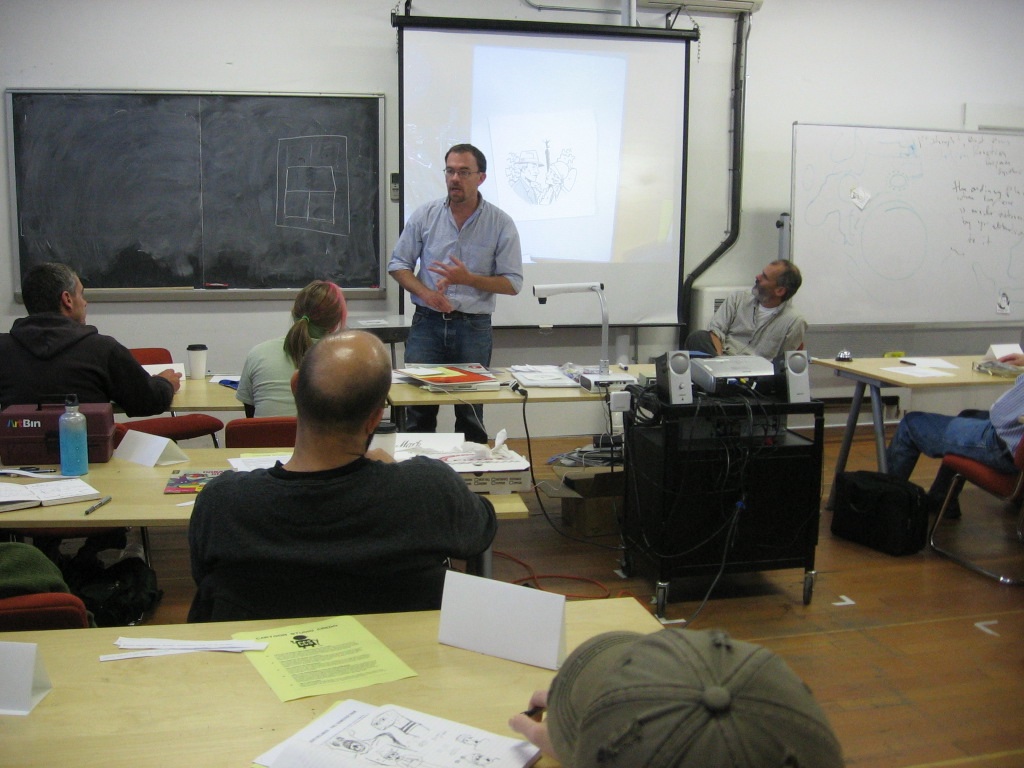 Lutes and Sturm in their natural habitat
The next question came from the audience, on whether– given the new Sequential Artists Workshop program in Florida and CCS’s success thus far– a new crop of small MFA schools might soon be in the offing. Sturm said that he favors a tiny model for education, and that if there were seven or eight such comics programs in the future, it would be “really sweet.” Lutes wondered aloud if there would be enough aspiring cartoonists to populate that many schools.
The panel was then asked what they wanted their students to get out of classes. Vaughn hoped to demonstrate that one can make comics anywhere and with anything, and to familiarize students with their own creative process. Sturm concurred that intimacy with one’s process is key; being able to pick it apart, like breadmaking, and identify exactly “where did I go wrong” is essential to improving and moving forward. Bramlett had two goals: The first, he joked, was “job security”– that not enough people know about linguistics and he selfishly wanted more people taking linguistics classes– and the second was to encourage deep reading and critical thinking. Learning how to read comics allows ample opportunity for the latter, as it’s a humbling new way to absorb information. (This reminded me of the Zen “beginner’s mind” concept, which I believe is an invaluable approach to most things.) Sturm added that critical thinking is necessary to decode and break down the media onslaught of the modern world. McKinney agreed with the value of becoming conscious of visual coding, noting that film and advertising use many of the same techniques as comics, and that he tries to impart that side of the reading experience to his students. He also pointed out that, while comics have yet to make major inroads into university settings, such institutions allow theorists and practitioners to be in the same place and thus for ideas to cross-pollinate. It was pleasant to imagine multiple rap sessions about comics in the classroom (and their practical uses) happening in diverse places around the nation beyond our weekend conference in the Tupelo Music Hall.
The next question went to McKinney: When it comes to teaching graphic novels in their original French form, what can be done about the sheer cost? (Apparently reading Epileptic in its six-volume incarnation would run ~$200.) He recommended ordering books directly from their French publishers and avoiding university booksellers, as they always jack the prices up. Bramlett has a good relationship with his local comics shop, and has been able to arrange a 25%-off bundle deal for his students. One suggestion– possibly from Vaughn– was to find a supportive librarian to help out with a reading list; if you’re strategic about your timing and a library or department has leftover money in their annual budget, you could direct those funds toward the purchase of trade paperbacks and accrue a collection over time. Another option was a group lending cart– that individuals could purchase a common discussion title and then an additional title of interest, and the latter would go into a shared book pool. (Sturm: “Nothing says ‘learning’ like volume eight of Death Note.”)
 Vaughn with one of her comics workshops
Coming up on the 3pm mark, the final question was on maintaining focus in the classroom. When dealing with comics, it’s tempting to veer off into related realms of pop culture, so how do you articulate to students what distinguishes the medium from film, fine art, prose, and so on? Lutes said that it’s an ongoing conversation– while film’s influence is often detrimental to comics, in the sense that it allows creators to overlook tools and techniques that make sequential art its own beast, Bissette conducts a weekly film series for CCS students in order to help broaden their understanding of expressive visual media. It’s important to absorb influences from all sources in order to move beyond a comics-only echo chamber, and so film and prose have their place. Vaughn mentioned exploring the storytelling tools unique to comics, and that CCS instructor Alec Longstreth gives an especially good lecture on the power of page turns. (True.) McKinney’s classes discuss the page turn as well, and the role of two-page spreads and serialization in storytelling and the reading experience. Lutes remarked how comics have staggering potential and great variety, and Vaughn added that the autonomy and control a solo creator has over their final product is immense. That said, Lutes joked, comics could use more editors, and the panel wrapped to enthusiastic applause.
The hour-and-a-half roundtable covered a lot of ground; its members represented various pedagogic disciplines that orbit an art form multidisciplinary to its core. As such, there were many worthwhile things mentioned only in passing. So here’s hoping that it has already sparked multiple long-term conversations! Given the passion and interest in the room, and the ICAF conference’s record attendance, I imagine they’re well underway.
Katie Moody
Librarian, The Center for Cartoon Studies
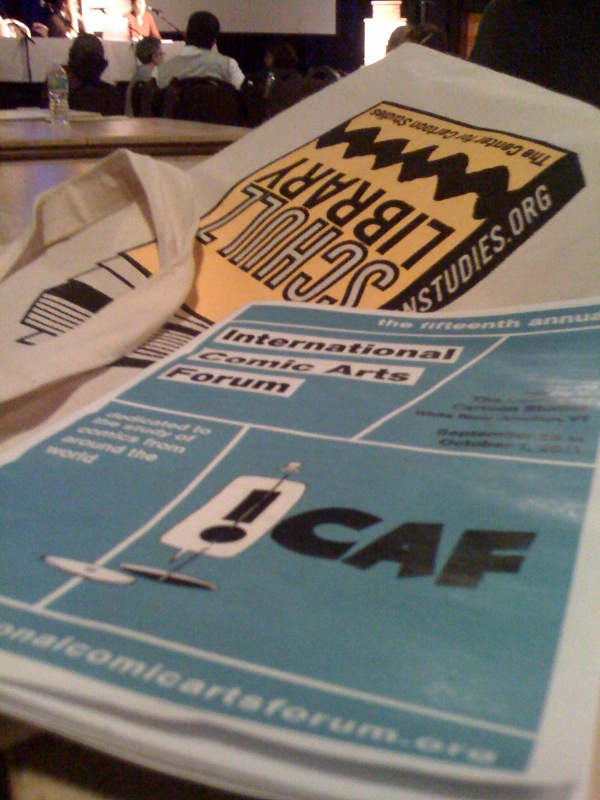 “You got your ICAF in my library!” “You got your library in my ICAF!”
