

 Cartoon Studies on Twitter
 Cartoon Studies on Flickr
 Get the latest news
It’s been a great couple of years for Montreal-based cartoonist Julie Delporte. In addition to having been The Center for Cartoon Studies’ Fellow for 2011-12, she’s released the wonderful Pigskin Peters Award nominated Journal through Koyama Press, the children’s book Je Suis un Raton Laveur through Canadian publisher La courte Échelle, and has worked on a francophone comics radio broadcast Dans ta Bulle in Montreal. If all that weren’t enough, she has a graphic novel, Everywhere Antennas, coming out through Drawn and Quarterly this May. I spoke with her via email this past week.
Carl Antonowicz: You were the fellow here at The Center for Cartoon Studies along with Blaise Larmee back in 2011; You’ve been fantastically productive since then, publishing not only your children’s book Je suis un raton laveur (which is adorable) but also Journal with Koyama press, along with the dozens of other projects you’ve had in the works. Do you think that your time at CCS helped you to become more productive?
Julie Delporte: The Koyama and La courte Échelle books published last year and the Drawn & Quarterly one to be published this year I started during my fellowship at CCS. Basically, I had nothing else to do than drawing: no job, no boyfriend, and not the same language as the people around. There was a bit of money provided, and all the students of the school around me (including my roommates) were working very hard… So yes, the CCS context helps to be productive! But I didn’t do half of what I wish I could have done. I’m someone with a lot of ideas of stories and concepts, and I feel really frustrated not to be able to draw and write them all. I’m not a hard worker, It’s painful to me to stay at my desk all day. I really wish drawing would be more physical, like dancing. Right now, I’m not so productive. I’m in that position where I have to start new books… And I don’t have a lot of self-discipline.

CA: I can see how being hunched over a desk all day might be unpleasant. Do you tend to work at a desk when you’ve got big cartooning stuff to work on, or do you usually work in a sketchbook?
JD: I wish I could work in a sketchbook, but I need a desk, or I feel like I need one! I want to try painting, so I need water and space, and then if I go out suddenly I’m missing a pencil of a specific color (or I feel like I need it)… Then I want to check a reference image on the web. I always feel like my set up is not the good one, or that I miss something in order to work. I guess all this gives me some reasons not to draw. But maybe it’s also like a ceremonial: I need my space, my tools, my objects, to be good and inspired.
CA: Your work always has a very personal, very honest quality to it. Much of the time–especially in Journal–it feels more like poetry than like narrative. Is this something that you consciously pursue, or does it just come out that way?
JD: I would have loved to be a musician just to be able to write lyrics. Sometimes I write my comics as if they were lyrics. But I never think of doing “poetry”, and my comics always seem always very narrative to me: what I’m telling, the content, is always a bit more important to me than the images. I don’t feel like I’m part of a trend of beautiful but strange and abstract comics, with no immediate understanding of what it is about.
But comics have such a tradition of classical narration that of course some people can feel I’m a bit on the side, and call what I do poetry or experimentation.

CA: Do you think of your work as being experimental? I mean, do you try to evoke specific emotions in your readers, or is it more intuitive than that?
JD: It’s really intuitive. But what I try is to do something different, something which is specific to me and resembles other comics as little as possible. And I like to experiment with new media. I was really into colored pencils for a time, but I hope I won’t be drawing with them the rest of my career, so right now I’m really willing to learn more how to paint. I guess this is called experimenting? When I’m thinking of specific emotions that I’d like my readers to experience, I see one thing: I want them to feel that they are holding a real object. That they are opening my own sketchbook (in the case of Journal), like if they found someone’s journal, forgotten in a cafe for instance, and can’t help but reading it. With the new book, which is fiction, I worked the same way. I want people to feel like they are opening the journal of my character. That’s why I’m working a lot to leave apparent all the creation process, pieces of tape, etc.
I think I need this because of the digital world, where nothing is material anymore. Plus I don’t like the fact the comic form is a totally codified art, invented from nothing connected to reality. I try to find a way to give more physicality to my work.
CA: You’ve got a book coming out this May with Drawn & Quarterly, correct? What’s that one about?
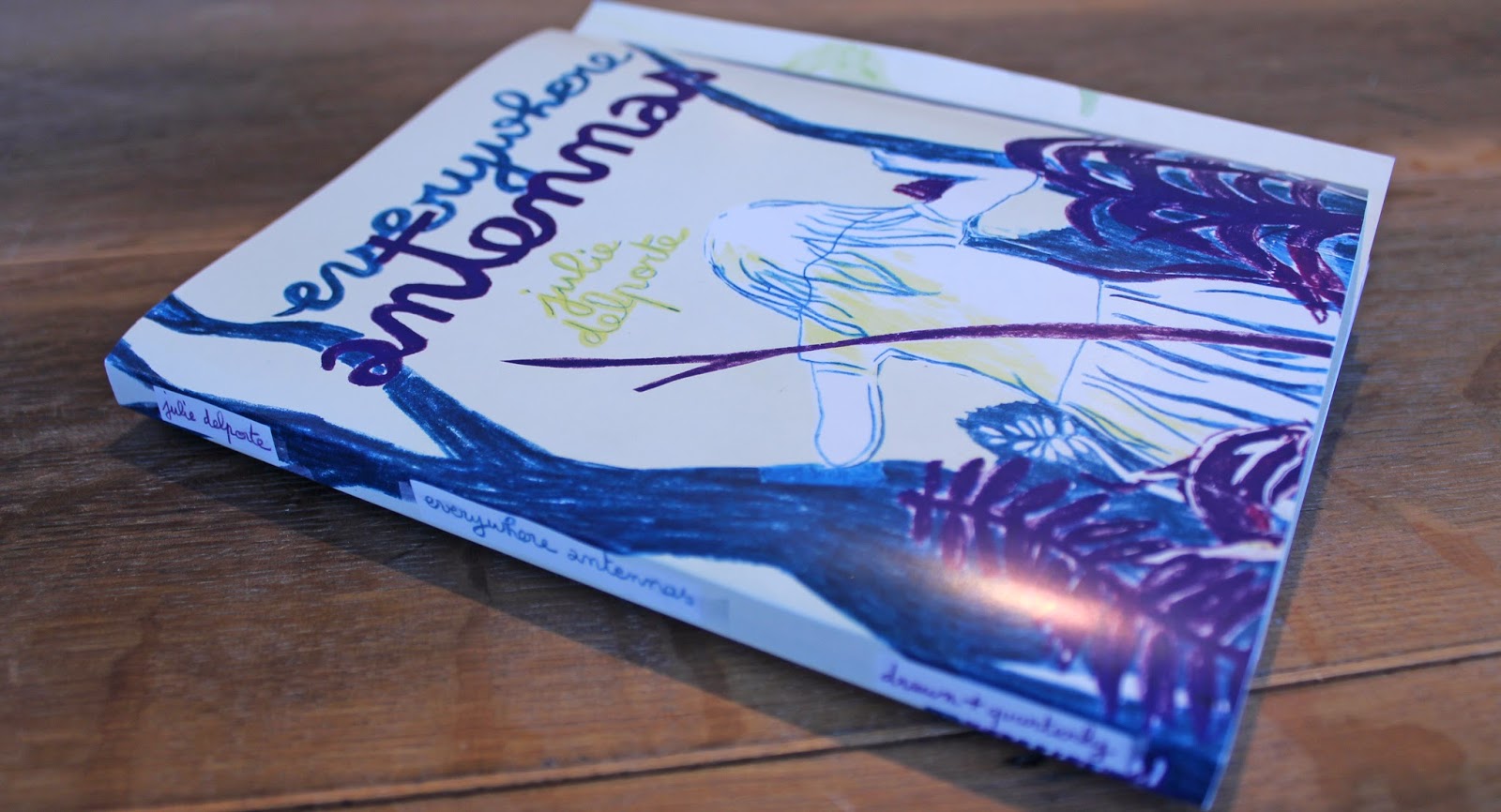
JD: Everywhere Antennas is the diary of a girl who is sensitive to electromagnetic waves (wifi, cell phones…), it give her headaches and all sort of weird symptoms, and she has to completely rethink her life. A lot of people claim to have this handicap, but only Sweden recognizes it. I didn’t want to do a documentary about this handicap, but it was very inspiring to take it as a start of my story. The book is also about the feeling that you have to adapt to modern technologies, and not the contrary as we are all told. And it is also about the fear of the invisible, the untold, when you feel something is wrong but no one else can validate what you feel.
CA: Do you personally feel out of touch with modern technology?
JD: I would love so much to live without this internet everywhere and the cell phone tyranny. The worst is Facebook where we see and know constantly things we don’t want to know. And I waste so much time on it… I imagine all the books I could have done if Facebook didn’t exist… But I’d like other people to get rid of it also, of course. I mean, I can’t live (right now) without that technology, but I dream of another evolution for human contacts and everyday life.
CA: You said in your exit interview with James Sturm back in 2012 that you’d like to do more bilingual comics, despite the fact that they’re more difficult. Have you been working more in English or French recently?
JD: Ah, I forget about that! I still feel like it would make sense in Montreal to mix more French and English in the book industry in general, but I didn’t put any energy into that.
CA: What do you think bilingual comics would look like?
JD: I’ll have to do them to know.

Delporte’s Everywhere Antennas comes out in May. Visit the Drawn and Quarterly website for a free .pdf preview.

One Response to Julie Delporte: Everywhere Antennas