

 Cartoon Studies on Twitter
 Cartoon Studies on Flickr
 Get the latest news
The Center for Cartoon Studies alumna Joyana McDiarmid launched a Kickstarter last month to crowd-fund the first two issues of her new bimonthly comics anthology Maple Key Comics. The project is an ambitious one, to say the least–McDiarmid’s first issue alone is over 300 pages of new comics from 17 different creators–but the community response thus far has been overwhelming. The Maple Key Kickstarter has already raised over $4,000 of its $7,000 goal in the first two weeks. Joyana and I met a couple of times this week to talk about Maple Key and her hopes for the endeavor.

Banner from the Maple Key Comics website. The image is from Luke Howard’s cover to the first issue.
Carl Antonowicz: So you’re putting together a bi-monthly comics magazine called Maple Key Comics. Could you tell us a little bit about how you got started on this idea?
Joyana McDiarmid: Well, going to The Center for Cartoon Studies and comics conventions, I saw this sort of empty space in the comics market. You had the people who were making…these fantastic little minicomics that you’d only come across sort of by accident. I started to notice the enormity of the gap between self-publishing and finding a publisher–a publisher who would treat your comics the way you’d want them to. Through the visiting artist seminars at CCS, a theme I began to see among these people who do great work and have good publishers was that a lot of [their success] was luck. It’s hard to be passionate about comics knowing that the endgame is based on luck–whether or not you’re going to find a publisher or find your audience.

Maple Key Comics’ Contributors Roster, incomplete. These and other fantastic cartoonists’ work will grace the pages of the forthcoming publication.
CA: Why did you choose to do something that’s a periodical rather than a one-shot anthology?
JM: There are a lot of one-shot anthologies out there. A lot of them are themed. I think the problem with that is that cartoonists have more to offer than short stories based around a theme. A lot of people want the opportunity to write a longer format story that will keep them drawing. Having a serialized story is very important, I think, to the psyche of cartoonists because you have a definite deadline for each section of your work, and you can accomplish a large story by taking little bites at it. That’s something that I found when I was doing my thesis project, which was based around little vignettes of 2-12 pages, having that deadline of “now I’m going to finish this vignette, now I’m going to finish this one,” I was able to accomplish about 80p in 5 months. That was incredibly rewarding. I think that having a serialized story helps you as a cartoonist in your career, too–people see your name out there, people see a publication and a story in which they can get invested. One of the models for that was Japanese manga magazines… They’re collections of ongoing stories where you get a chapter at a time. The stories within the magazine vary widely between genres and the kind of storytelling they use. All they really have in common is that they’re manga. I really enjoyed that idea of being able to continue a story.

A “Weekly Jump” cover. Oh man, check out that Luffy. He ate all the rubber fruit. Image courtesy of whatismanga.wordpress.com
CA: Maple Key is going to be something like the way MOME was, then? Like a collection of on-going and one shot stories not really tied together by their themes?
JM: Yes, the difference is that Maple Key focuses on serialized stories. MOME had a few of those, but they started and stopped at different times; in Maple Key the ongoing stories begin and end together.
There is no theme, the point of Maple Key is to let cartoonists tell the stories they want to tell. The layout and design of the magazine will make the transition from one story to the next clear. This way people won’t get confused as to what story they’re reading.
In Maple Key stories run either 3 chapter or 6 chapters. The stories that are 3 chapters long are split into two groups, the first batch running in the magazine from issues 1-3, and the second batch runs in issues 4-6. 6 chapter stories will, obviously, run in all 6 issues.
CA: You’ve talked about Maple Key being something that sort of bridges the gap between minicomics and graphic novels or periodical manga. Why did you choose to make Maple Key Comics a single-volume affair rather than something that’s a collection of small books? Why not do it in a format more like Charles Forsman’s Oily, or what the Dog City boys are doing, where it’s a bunch of little books in a box?
JM: I am a notorious overpacker. I will put every single book I think I might want to read in my bag and sometimes they get beat up, they get lost, I might not have packed the second volume of the story I want to continue reading…When I was living in Seattle, I commuted everywhere on the bus. Having a bunch of comics floppies in my bag was really annoying–and I love the format, I love the way Chuck packages things at Oily, but those stay in my house. I don’t take them with me to read at a coffee shop. So that’s sort of the idea behind having them all in one book–you can have a variety of reading material. Although, the first issue is 300 plus pages, I don’t know how portable it’s really going to be (laughs).
CA: 300 pages is about the size of a normal paperback novel, which people bring with them everywhere, so I wouldn’t worry too much about that.
JM: Oh yeah. But the idea is to have something portable, something that is cohesive in its design.And, as a person who works in a library, I like the idea of being able to neatly put your minicomics on your shelf
All my comics I get from friends and at conventions live in six shoe boxes in various states of organization. When I want to re-read one I have to dig through all my boxes to find it, because no matter how well I think I’ve organized them, I have no idea what is in what box.
Don’t get me wrong, I love minicomics and what Oily and Dog City are doing. There is something really special about handmade comics. This format is just what I’ve decided works best for what I want to do with Maple Key. I want to focus on the stories, keep the packaging neat and crisp, and have a book and ebook that I can get out into the wider world. I want my contributors to be able to reach a wider readership, we can help each other out, they may pick up Maple Key for Sophie Goldstein and find that they love Sasha Steinberg’s comics just as much.
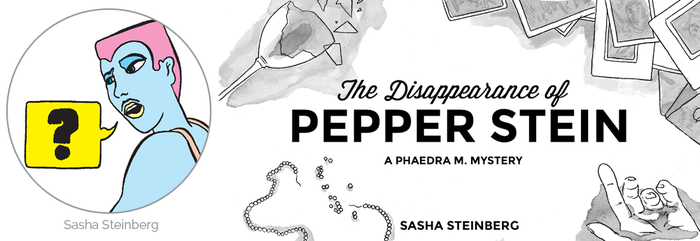
Promotional header for Sasha Steinberg’s new story, debuting in Maple Key Comics #1.
CA: So by packaging all these creators together you intend to sort of pool interest?
JM: Absolutely. Something I have been privileged to experience by going to CCS is a sense of community with other cartoonists. We may feel competitive sometimes or have a pang of career envy, but we want each other to succeed. The world of comics has room for all of us, and if it doesn’t, we have to make room.
So we help each other out.
The publishing world can be brutal to break into, and some of it has to do with luck. I’m hoping that Maple Key Comics will be able to give the cartoonists that contribute a little more luck. They can say to publishers “I’ve been in this magazine, I drew a six chapter story for it. I have follow through, I have an audience.”
CA: What’s been interesting to me about the run of your Kickstarter–and about Kickstarters in general–is that they are already so community-based. Like each of the Maple Key contributors is getting a spotlight, which encourages them to share the link to the Kickstarter to their networks, etc.
JM: Kickstarter itself is community based. The people who run it encourage those who use it to be open, honest and transparent with their backers. They like to generate a feeling that we’re all in this together. And I feel that with this project. Maple Key is about the comics that are in it, and the creators behind those stories. It makes sense to spotlight them, get people interested in them and their comics before the issue comes out. And, once again, we all reach out to our friends and our readers (and our families. Parents are the best backers) and they get interested in the other cartoonists involved with the project. That way our circles grow. The Kickstarter marketing is doing exactly what I hope Maple Key will do, widening each of our circles.
Am I getting too hippy-dippy, lovely-dovey, feel-goodie?
CA: No, not at all. The first issue, you said, is going to be somewhere around 300 pages of comics, correct?
JM: 300 pages, it’s really amazing. The contributors are pushing themselves to create some great comics, they are dedicated to their art. Once I realized the first issue was over 260 pages I got another quote from the printer I wanted to use, and it had doubled. I had to change printers, but I’m not complaining, there are 17 creators doing what they do best.
CA: Facilitation and creation are two kind of intertwined aspects of a work like Maple Key. Could you talk a bit about how you see those interacting in your own work?
JM: I crave an editor for my own work these days. I think it is a combination of working as an editor and not being in school anymore, where I had constant feedback.
And as a cartoonist, I know what to look for at each stage of someone else’s work when I am editing it.
CA: It’s kind of unusual that you’re both an editor and a practicing cartoonist; I feel like most people have to jump one way or the other eventually. On which side do you see yourself falling if it should come down to that?
JM: Oh no, I hope that doesn’t happen. I would say cartoonist.
I like editing, I like all that goes into getting a comic to print. Well-designed books make me very happy, I enjoy adding all the little things that make a book look polished.
But I love cartooning the most.
The thing keeping me sane during the stress of running a Kickstarter is being able to tune out for a couple of hours and make comics.
CA: The first couple issues seem to be focused primarily on CCS alumni and affiliates. I assume you plan to expand the scope of contributors?
JM: Definitely. I reached out to non CCSers when I was inviting people to contribute, but I’m a no-name. The people willing to take a bet on me are the people who know me. My hope is that as my cartooning circle grows and the readership of Maple Key grows other cartoonists will want to join in.
CA: You said that you’ve got plans to use MKC as a springboard to launch the parent company Samara Press into something more like an art books publisher. Do you want to talk a little about that?
JM: Samara Press is my five year goal. I want to see how Maple Key goes this year, six issues. If it goes well I want to continue into a second year, maybe publish some comics separately from Maple Key, like a collection of work or a one-shot. And if that goes well, so on and so forth.
I like that there are several micro-press comics publishers, it gives cartoonists more options to get their work printed. Samara Press would be like that, a way for great cartoonists to focus on making comics while we do all the other stuff. Stuff like printing, distributing and advertising. Doing that on your own is almost a full time job.
Digital platforms for comics are quite up there for readability and profit. Samara Press would look into ways in which we could make comics more easily read digitally, and how artists can make some money on their digital comics.
It’s something that no one has really cracked the code on yet.
I don’t presume to think that I’ll be the one to do so; I just want to keep my eyes on those kind of projects.
CA: One last question: How has the Center for Cartoon Studies helped you in this endeavor?
JM: As an alumni of CCS I was eligible to apply for the Inky Solomon Center Grant, a grant given to the school by the state of Vermont to help alumni with business ventures. So I did. And I got it. This meant that I had a little money to start a website for Maple Key, and that I had access to business planning resources. Some of the faculty at CCS and president Michelle Ollie sat down with me and helped me brainstorm what I needed to start Maple Key. It was the first major spark that made me think “Yes, I can do this.”

From the Maple Key Comics website.
The Maple Key Kickstarter is at the time of this writing over halfway funded, and due to finish on 19 Februrary. The first issue is due out in April in both print and digital formats, and will feature work from Bill Bedard (CCS ’12), Neil Brideau, Jon Chad, Rachel Dukes (’13), Sophie Goldstein (’13), Laurel Holden (’13), Luke Howard (’13), Laurel Leake (’13), Josh Lees (’14), April Malig (’13), Joyana McDiarmid (’13), Mathew New (’14), Will Payne (’14), Dan Rinylo (’13), Sasha Steinberg (’13), and Iris Yan (’13). Backers can get subscriptions, high-quality prints from contributors Howard, Leake, and Rinylo, or pieces of original art.
