

 Cartoon Studies on Twitter
 Cartoon Studies on Flickr
 Get the latest news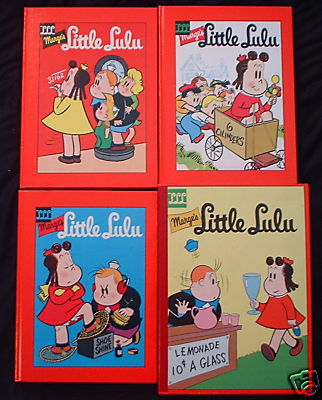
Looking for something to brighten the summer weeks?
In the pantheon of great mainstream comics, few came close to the popular Dell Comics run on Little Lulu, which writer/cartoonist John Stanley (though he only drew the earliest issues of Lulu, when they debuted as part of Dell’s ‘Four Color’ one-shots). Stanley scripted Lulu from 1945 to the end of the 1950s, a run almost as extensive as Carl Barks on Donald Duck and Uncle Scrooge.
Stanley’s erstwhile collaborator was Irving Tripp, who came aboard once Little Lulu became its own series. It was initially a bimonthly when it was launched in 1948, but was monthly from 1949. That’s a lot of comics — and a ton of stories — from the amazing Stanley/Tripp team, and they remain among my all-time favorite comics for all ages.
Little Lulu was created in 1935 by Marjorie Henderson Buell (who signed her work ‘Marge’) in the pages of the popular newsstand magazine The Saturday Evening Post. Marge’s Lulu was usually confined to single-panel gag cartoons, with only occasional multi-panel gags, and these delineated Lulu as a scrappy, difficult child with a powerful tomboy streak. Though it’s important to honor Marge’s body of work on its own terms — and the monumentally successful career and international Lulu licensing empire (which included the Dell Comics series, animated cartoons, merchandizing and more) Buell springboarded from her Post cartoons — it’s also vital to acknowledge all that Stanley and Tripp brought to the character. Stanley and Tripp expanded upon Buell’s single-panel Lulu universe to create Lulu’s neighborhood and a diverse cast of characters unique to the Dell Comics series.
Primary among the cast were Tubby and Iggy and their circle of friends who were locked in an eternal gender-war with Lulu; she naturally bristled at the “No Girls Allowed” boys clubhouse Tubby lorded over, and Stanley and Tripp found infinite avenues to explore the ingenious means by which Lulu and her friend Annie persistantly challenged (and usually triumphed over) Tubby’s cottage patriarchy. The feud led to the invention of ‘Mumday,’ the first day of the week in which the boys weren’t permitted to speak to any female (including their own mothers), but it occasionally had to take a back seat to turf battles with the West Side Gang.
Stanley and Tripp also revelled in the imaginative life of their characters: Lulu’s Witch Hazel and Little Itch stories, told to terrify her neighbor Alvin; Tubby’s pulp-detective alter-ego The Spider, who more often than not targetted Mr. Moppet (Lulu’s poppa) as the culprit behind whatever crime was at hand. I think these stories are among my favorites, and Tubby is definitely one of the truly great characters in comics history — he’s a suburban Tuco, if you will, and the never-ending war-of-wits between Lulu and Tubby is possibly the most intensive manifestation of the Post-WW2 and Eisenhower Era arena of gender conflict. It’s certainly the most entertaining!
John Stanley’s dark streak also marks the Little Lulus. From his rare Raggedy Ann and Andy work for Dell to his post-Lulu run on Nancy and Sluggo and most of all his seminal scripts for Dell’s 1962 Tales from the Tomb and Ghost Stories #1, Stanley proved he could chill the spines of young readers as handily as he tickled our funny bones. The latter two Stanley-scripted classics, despite their erratic artwork, marked a generation of future cartoonists, including the Hernandez Brothers and yours truly. I had nightmares from those comics — as I did about the basement in Little Lulu!
Re-reading the Lulus, I was surprised to find direct parallels between some of the Lulu stories and Stanley’s Tales from the Tomb and Ghost Stories #1 scripts — including a chestnut about a dangerous rug, believe it or not! One of my friends in Montreal has traced some of these tales back to pulp writer Jean Ray (author of the novel Malpertuis); we’ll be writing about that sometime down the road. (Note: Maggie Thompson’s short articles on the correlation between Stanley’s horror comics and Lulu is worth checking out; it’s in one of the hardcover volumes of Lulu in the Schulz Library.)
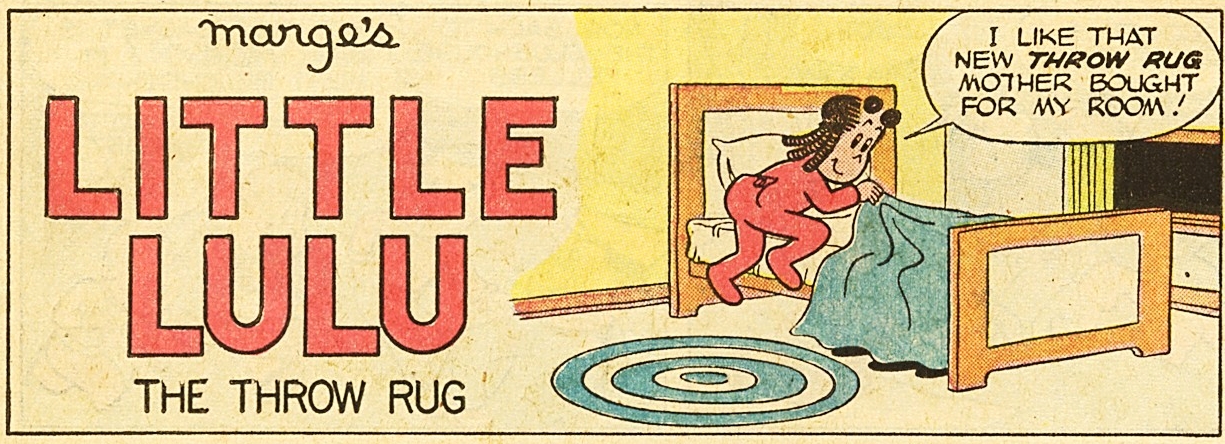
I’ve already mentioned Lulu’s Witch Hazel stories, but Stanley and Tripp constantly played on childhood fears of dark basements and open doors — something lurked under beds and in unlit basements, vines could reach into bedroom windows and pluck hapless children out of their beds, and Lulu’s scary stories often involved manifestations of such terrors. Stanley’s later comics overtly played with this Lulu undercurrent: there was Oona Goosepimple’s haunted house brimming with weirdo kin and the nasty little Yoyos (which nested behind the fireplace) in Nancy and Sluggo, making the bed for Stanley’s delightful solo series Melvin the Monster (1965-69, 10 issues).
At one point Stanley and Tripp dared to reveal a decidedly phallic, monstrous Bogeyman lurking in Lulu’s basement in a story that never saw print in the Dell series, as Marjorie Buell nixed the completed story as being inappropriate. Thankfully, that never-before-published story is in one of the volumes we have in the Schulz Library. Worth a read, indeed!
Thankfully, we have a healthy collection of the Lulus in the Schulz Library, including at least a few volumes of the hardcover Another Rainbow boxed set editions and the more recent Dark Horse Comics reprint paperbacks.
I’ve no doubt we’ll be latching onto the upcoming D&Q John Stanley collections, which reportedly will include his 1960s teen comics collaborations with artist Bill Williams, Kookie (two issues, 1961-62) and Dunc & Loo (8 issues, 1961-63), which were among his final mainstream comics works. I naturally hope these will also reprint the comics Stanley wrote and drew in this period (Thirteen, Going on Eighteen; 26 issues, 1961-67, and of course Melvin the Monster) — time will tell!
In the meanwhile, though, soak up some Little Lulu!
– Guest post from Stephen R. Bissette


Pingback: Irving Tripp, R.I.P. | Robot 6 @ Comic Book Resources – Covering Comic Book News and Entertainment