

 Cartoon Studies on Twitter
 Cartoon Studies on Flickr
 Get the latest news
Jen Sorensen is a political and journalist cartoonist. Originally from Lancaster, PA, she came to visit The Center for Cartoon Studies (CCS) from Austin, TX. She has a degree in cultural anthropology, which has been useful in her career observing and commenting on culture. In 2014, she won the Herb Block award. She is now the editor of Graphic Culture, the comics section of the website Fusion, aimed at diverse young adults. Her proudest moment is when her name was included in the Time Out New York crossword puzzle.
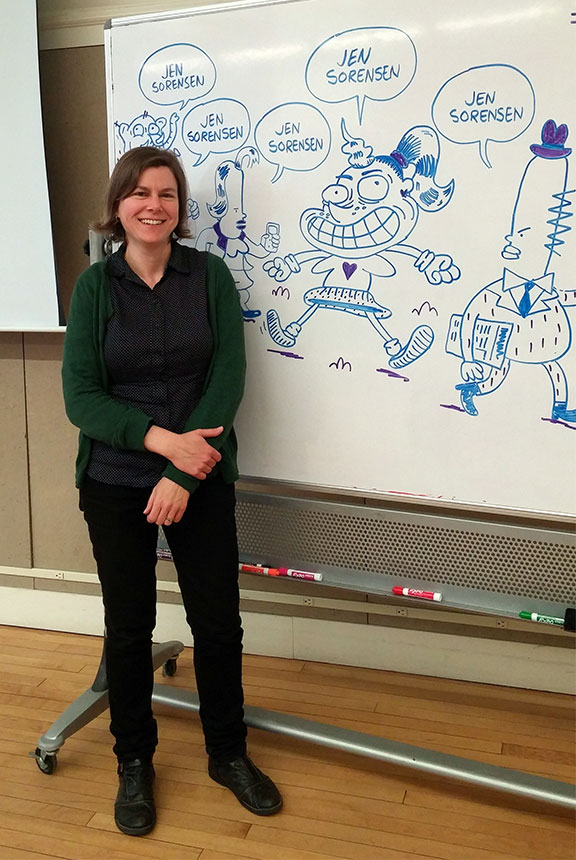
Jen with her visiting artist illustration
Jen’s comics started out more surreal, inspired by R. Crumb and alt weeklies, such as her funny short stories in Drooly Julie, the female pervert. Then 9/11 and the 2000 elections happened, and everything got serious. She lost her sense of whimsy for a while, leading her to more serious work. Having worked on both story journalism and political comics, she says it is nice to not have to invent things like jokes when working on a story. But these real stories take longer; there’s more winnowing down. She likes jumping between the two types of comics.
She publishes her political comic, originally Slowpoke and now just called Jen Sorenson. The comic is due to her publisher Monday mornings. Because she has a job as an editor at Fusion, this weekly strip is usually postponed until Friday or Saturday. She spends the week keeping up on issues through Twitter and other online methods. Then she picks a topic and doodles while nearly napping. She finds that the edge between awake and sleep is great for creativity. The pencils and inks take about eight hours. She uses a Faber-Castell Pitt brush pen and Pitt fine artist pen; and a Tombow pen for lettering. The she scans the images and uses Adobe Photoshop to add panel borders and color. Because it is an alt weekly strip as opposed to something more traditional, she finds she has tremendous freedom from editing. The comic is self-syndicating, which means each newspaper can choose to run each comic or not. Only two papers have not published a comic, and these were separate comics in unique situations.
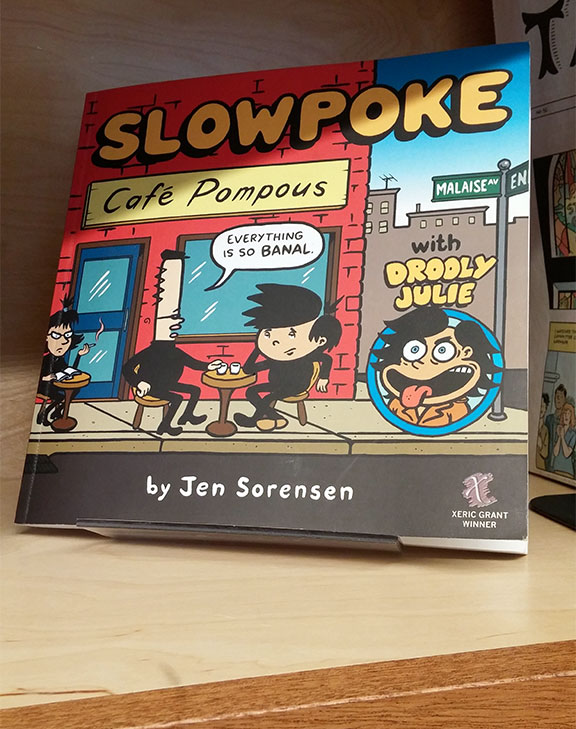
Jen Sorensen’s book, Slowpoke, at the Schulz Library
She recently published a comic called “The Phone Rang. It Was My College Rapist.” When the Cosby allegations came about, a friend told Jen her story and asked her to draw it. She approached Jen in November, writing her memories, her account of things. Then Jen followed up with questions; there was lots of back and forth. Jen sent the script to her editor, who had more questions; there was more back and forth. And then Jen finally started drawing. It took two weeks to get to the finals in Photoshop. She enlisted a friend, Kevin Moore, to help color. The process took three and a half months from the first telling of the story to completion, though she was not working on it the whole time. Throughout the process, Jen would periodically ask her friend again if she was sure she wanted her story published. Jen didn’t want to make her uncomfortable. But her friend has a pretty healthy attitude; she was very satisfied to see the comic. It seems to have helped her get closure, and it has raised awareness. Telling another person’s story takes a lot of time. This comic came at the expense of getting other things done, but it was a positive experience.
As a political cartoonist, Jen made sure to discuss the recent events with Charlie Hebdo with the students. She has found that two separate issues are being lumped together. One is free speech, a cut and dry issue. She has interviewed cartoonists across the world, and people universally approve of free speech. Two is the response to actual comics: a huge range. Some people discuss it like Bush-era supporting of the troops – you are with us or against us; you can’t criticize the comics at all. But others feel we should be free to talk about and dislike the comics. Jen feels that several of the cartoons aren’t as bad as they seem at first glance once given context, but some are outright Islamophobic and alienating. And this second issue is the one that needs discussing.
One of her main tips for aspiring cartoonists is to keep plodding along because things will happen unexpectedly. Weird opportunities will come out of the blue. As part of this, she has found that being a cartoonist is now about being diversified. It used to be that a political cartoonist was just hired straight out by a paper to come in and make a political cartoon every day. Now, she is a freelancer, public speaker, and comic editor. Marketing yourself is also more about your personality than just an end product. News about comics often ignores the artist of a comic as they do about no other media. Cartoonists are seen as VUPs, as she put it – Very Unimportant People. You must cultivate your personality on Twitter and Facebook.
When drawing, she urges cartoonists to keep lettering in mind. Be concise and legible. Break up your text when need be. So many cartoonists care nothing for lettering. If you need to, you can make a font, but Jen still letters by hand. She also urges cartoonists to try to having something to say, especially if you are trying to get published. Is your story actually interesting? And she reminds you: don’t forget to read. Read everything – newspapers, magazine – because it helps you think about the world.
Jen likes to think about making political cartoons like the doctor’s oath – do no harm. As she put it, “punch up, not down.” She finds there is no real line she won’t cross except whether it will make an interesting or funny cartoon. If not, she doesn’t make a comic, even though she might want to comment on the subject. With political cartoons, you must have thick skin. That is why she follows this rule, which allows her to make comics she can stand behind. And probably why overall she gets polite feedback. She finds there are certainly bad days and specific cartoons where people argue about it more. But her style is less openly aggressive and antagonistic. In the last few years, she has noticed a slight uptick in anti-feminist comments, but this has been a relatively small taste.
In regards to publishing online, Jen has found some limitations to the web. Everyone seems overly obsessed with tracking readership and shares. This trend means there is less push for publishing experimental work. She found that alt weeklies were freer. As she put it, alt weekly cartoonists are like giant pandas; they can survive only in a specific environment.
You can keep up with Jen on her website, Twitter (@JenSorensen), or Facebook. Her books, Slowpoke: Cafe Pompus and Slowpoke: America Gone Bonkers are available online and in your local comic and book stores.
The following are portraits of Jen by some current CCS students.
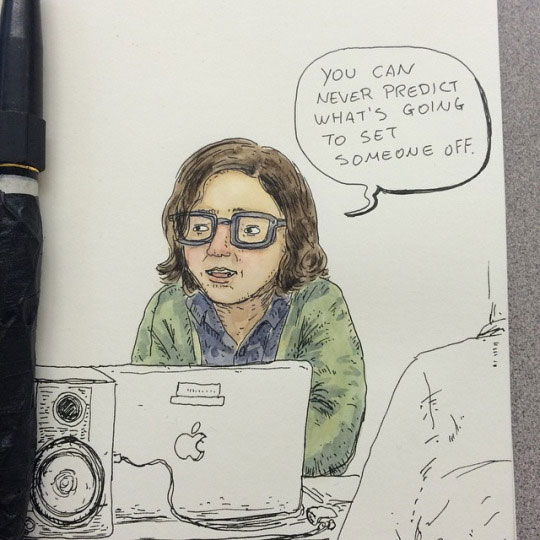
Portrait of Jen by John Carvajal
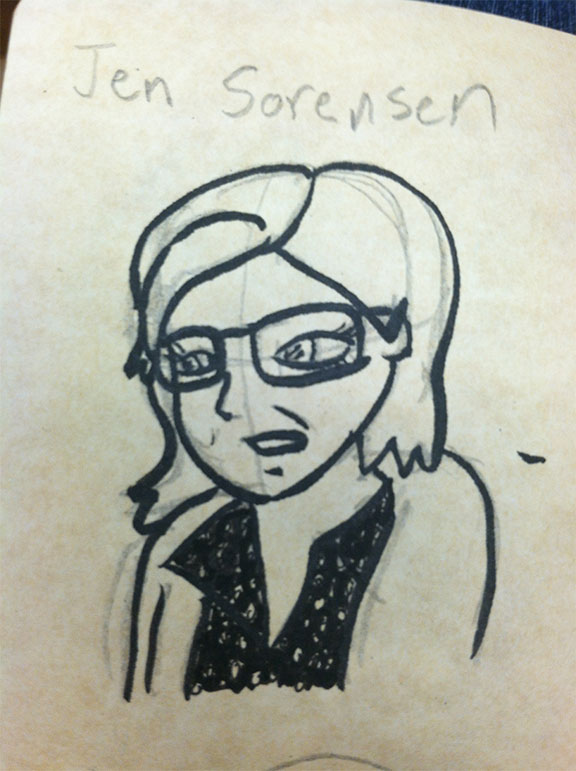
Portrait of Jen by Alex Karr

