

 Cartoon Studies on Twitter
 Cartoon Studies on Flickr
 Get the latest news
Center for Cartoon Studies Alumnus Dakota McFadzean has a pretty dark sense of humor. In his often surreal daily strips–appropriately entitled “The Dailies”–death, cosmic insignificance, facial mutation, and ghosts are all used to point out the absurdity of life and the fundamental loneliness of the human condition, more often than not to humorous effect.
In addition to a steadily-increasing pile of strips embodying some of the bleakest humor in comics, McFadzean was also included in Best American Comics 2012, co-edits the anthology Irene with fellow alumni dw and Andy Warner, and recently released a collection of his own work called Other Stories and the Horse you Rode in On through Conundrum Press.

I had a chance to talk with Canada’s Crown Prince of Comics over gchat recently. Here’s how that went:
Carl Antonowicz, Ace Reporter: Other Stories and the Horse You Rode in On was also the title of your thesis at the Center for Cartoon Studies, correct?
How does the Conundrum book differ from your thesis?
Dakota McFadzean, Lord of the Northern Territories:I guess they’re similar in concept in that they both follow the whole “here’s a bunch of mostly unrelated things” thing. I liked the convoluted title enough to use it again. The Conundrum book has two or three stories from my CCS thesis, but most of the stories are newer than that.
Oh, and I included a couple of stories I did during my first year at CCS that weren’t eligible to be included in my thesis. Also, there are no strips in the Conundrum version. Just short stories and a one-pager.
CA: When you were pitching the book, did you use your thesis as the submission package?
DMF: Sort of. Andy Brown at Conundrum approached me the fall after I graduated and asked if I wanted to submit a proposal. I remember it having a short turnaround for some reason, so I printed a condensed ashcan version of my thesis that cut a bunch of the dailies and added new work I had done over the summer. Now that I think about it, it was a pretty unprofessional looking package, but I was afraid of delaying too long.
CA: You really hit the ground running after CCS, it seems. You’ve been doing your Dailies for, what, two years now? Three?

Do you have any plans to collect those in a big book?
DMF:I think I had a couple of lucky things happen in combination with one another. I still struggle with the networking, project-pitching thing. I always feel like I’m behind or between projects.
The Dailies I started at the beginning of January 2010, so I guess it will be four years in a couple of months. I haven’t collected them yet, but I get asked that a lot.
I actually did a small minicomic version for MoCCA one year, but it was kind of last-minute and didn’t really sell well. I don’t know what I think of collecting them in print. I mean, I love the American Elf collections, and I love print. But I don’t know– it seems weird considering I have them all on my site.
A friend saw my originals the other day and said I should print them at-size with no editing. Keep all the ink texture and spelling mistakes. I like that idea, but I don’t think that would be interesting to many people until I’m an old, dying cartoonist reflecting on his career.
CA: I hope that stays a long way off for as long as possible.
DMF:Me too. So far, so good.
CA: Speaking of which, there’s a lot of focus in your dailies and to a certain extent in your longer pieces on age–youth, old age, middle age, etc.
What, in particular, about aging interests you?

DMF:Yeah, I’m not sure why I return to that over and over again. I guess it’s something I think about a lot when I’m inking. The inking process is so meditative, it gives you time to let your mind wander. So I think about different times in my life, or things that I’d like to happen, things I’m afraid will happen. I think about time and memory a lot in relation to comics because so much of laying out a page is about time and memory– trying to evoke little truthful moments.
I guess I like the idea of aging because it’s universal. So no matter how specific or different characters are, there’s an equalizer there, and it’s something that informs everything we do.
There’s also the fact that comics take a long time to do, as you know. So, I often think in terms of how many comics I can get done in a time period, and when I’m doing a strip every day, it feels a bit like a ticking death clock. But I mean that in a good way, not a sad depressing way.
Oh, and one more thing about that: I like having disparate ages because they provide different perspectives on related experiences. A kid character is experiencing everything for the first time, but an older might be wondering if they’re experiencing something for the last time. I realized a few years ago that even if I live to be 100 I’ll only see around seventy more springs. That doesn’t seem like very much.
So, hooray for finiteness, I guess.
CA: Ha! I’m not sure I can imagine a ticking death clock as anything but depressing, but YOLO, I guess. Is it death that makes life worth living? Or is it the punchline to a joke that goes on too long?
DMF:It could be both. I guess it gives meaning to the time we do have. In a less overarching way, when I have too much time on my hands, I don’t feel as driven or productive as when I find myself really busy.
I find this stuff fun though. The universe doesn’t mean anything and that’s really scary and funny.
CA: Do you find yourself bucking against the task of churning out a strip every day?
DMF: As for the drawing a strip every day, it seems to go in waves. Most of the time, I don’t think about it anymore and it’s just a routine like brushing my teeth. But once in a while, it’s the hardest thing in the world, and I’ll spend each night of the week staring at a blank page for an hour before doing something I feel dissatisfied with. But, the more I do it, the less often that seems to happen. The nice thing about the exercise is it removes some of the stakes. I think, “Oh well. Tonight’s strip sucks, but maybe tomorrow’s will be better.”
It’s kind of a micro version of doing longer comics, but it doesn’t take months to do a strip. I dunno, maybe I need that spontaneous, instant gratification of finishing something to balance out the months it takes to do longer comics.
CA: That’s a very positive way of looking at it. Would you describe yourself as a nihilist?
DMF: I don’t know if I’m a nihilist. I think I get really excited by how incomprehensible and uncaring the universe is. But, I like this thing we have going on our little planet. Maybe it doesn’t mean anything in the larger scope of things, but it feels good when you spend time with friends, or someone holds the door for you, or you see a cat get spooked by a leaf.
So, I guess nothing means anything, except to us because we pretend it means something, so it does. What’s that called?
CA: Isn’t that subjectivism? Solipsism? Positive Nihilism?
DMF: Yeah, all the main hits.
CA: So in addition to age, you have a lot of weird face stuff going on in your comics. Do you think that’s an alienation thing?

DMF: Hmm. It could be. I guess it starts with this urge to draw warped faces, that’s often my go-to in my sketchbooks. For whatever reason I have this urge to stretch, obscure, remove, and dissect cartoon faces. I think it’s funny and disturbing.
I do have a lot of alienated characters, though I don’t usually feel especially alienated. I spend a lot of time by myself, drawing and going for walks, so that could be why so many of my characters do that.
Most people respond to faces though. I like that about being human– the way we see faces in everything. As though the moon and electrical outlets are reflections of ourselves. I like it when my digital camera ‘thinks’ there’s a face in a background detail and tries to focus on it. Faces are such a focal point of how we understand one another, that I think using cartoon physics to play with that sometimes leads to some interesting results.
That whole seeing faces in everything is part of the reason comics and cartoons ‘work’. too.
CA: I recall Scott McCloud saying something about that in Understanding Comics.

DMF: Yeah, he has that whole chart of different levels of realism and abstraction. It really makes you realize how willing our brains are willing to go to see another face.
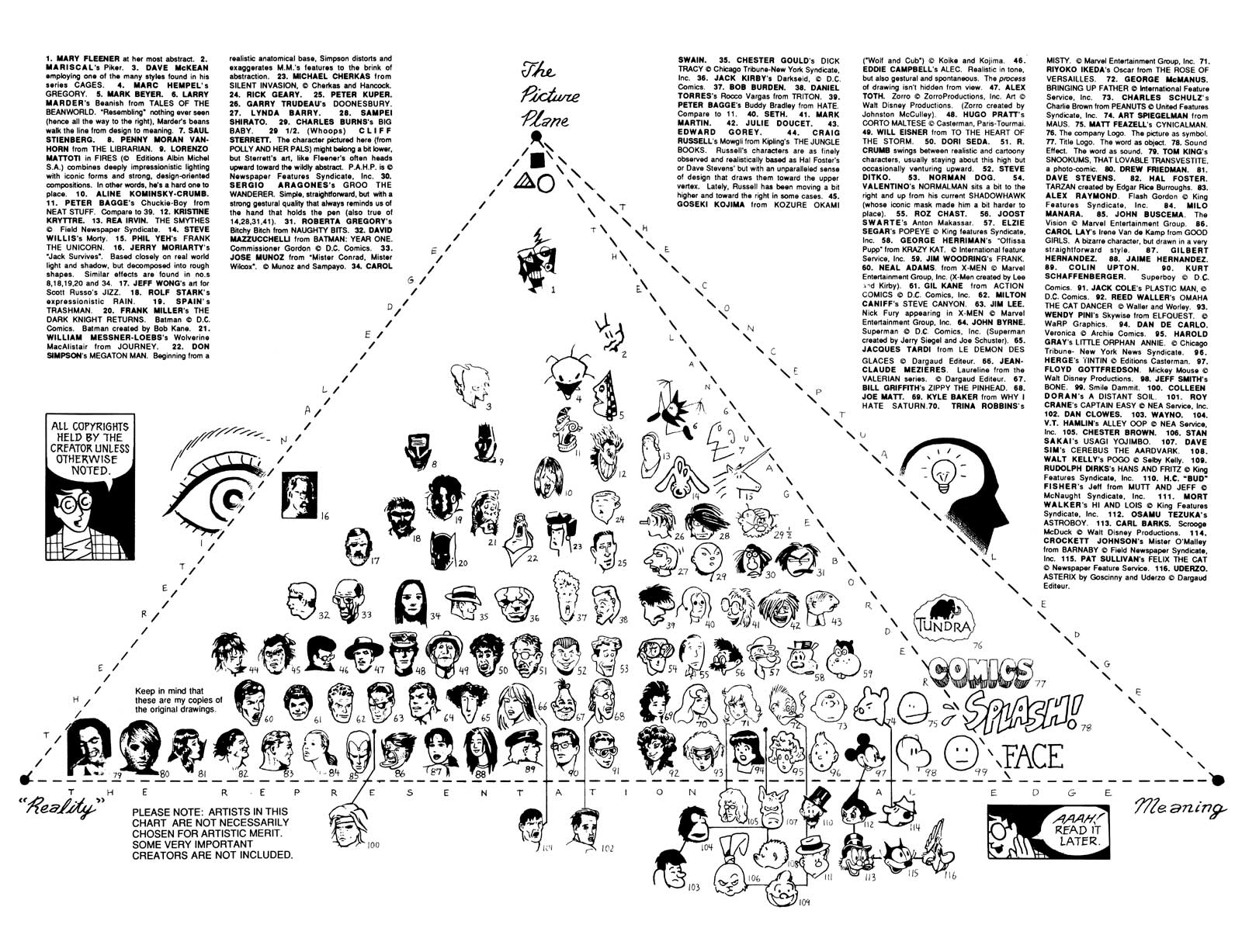
CA: Have McCloud’s theories been a big influence on your work?
DMF: When I was in my early 20s I was really into Understanding Comics. It was a massive epiphany for me. But I actually haven’t read any of his stuff in a while. I feel like I’ve been spending most of my time since then trying to get my hands to learn what my brain knows.
I did my undergraduate degree in fine arts, majoring in drawing. It was all conceptual, installation, interdisciplinary gallery art kind of stuff. I’ve kind of fallen away from being engaged with that world, but I always appreciated how we were encouraged to look at everything from so many different perspectives: the medium, the scale, the historical connotations, every aspect of an artwork is part of what informs its content. Reading Understanding Comics taught me a lot about the innate formal qualities of comics.
Of course, it slowed down my cartooning development, I think, because I spent too much time overthinking every little move I made (which relates back to the Dailies and lowering the stakes so I can just follow impulses.)
CA: Do you think that the Fine Art world and the Comics world are irreconcilably separated, or do you think the two can meaningfully interact?
DMF: That’s funny, a bunch of cartoonists were talking about this on twitter today. I don’t think they’re irreconcilably separated. I’ve seen a lot more interaction between disciplines over the last ten years. This question is a big can of worms, but I do think things are improving.
When I started my undergrad in 2001, I one of my favourite instructors pull me aside and basically tell me I was wasting my time with comics, and that I’m going to get bored with the limited possibilities. He thought it was all superhero stuff. Years later, he saw some of the things my brother and I were doing and he said he understood now.
So, I don’t know. That’s anecdotal, but you see comics present in literary circles, awards, grants, that kind of thing. There was definitely that vibe at CAB, with the Spiegelman retrospective opening. I heard a lot of the old guard cartoonists basically saying that this is the world they dreamed of.
I guess we just need to treat comics like a fine art because they are. There’s no reason to get upset about it. I’m sure poets feel marginalized by the other disciplines too. Cartoonists often seem to think there’s going to be a beam of light and angels singing when comics are finally accepted by the fine art world, and I’m not sure why we care about it so much. It’s happened. Most artists are pretty focused on their own things anyway, so really, all the arts should interact more often.
Before I came to CCS, I used to keep my comics in a folder on my computer that was separate from my ‘art’ stuff. Then I was doing a studio visit with a curator from a local gallery, and she thought that was silly.
CA: I’ve definitely seen a few fine artists do comics, and a few comickers do fine arts, but very rarely for any length of time.
DMF: Yeah, it’s tough because all arts are related, but the specific skills and processes necessary to work in different disciplines is pretty disparate.
Plus everyone is so hung up on the whole idea of ‘getting it’.
They’re worried they’re not getting it, or that they won’t get it in the right way.
CA:Is there a ‘right way’ to get art? (I guess yours in particular, but whatever.)
DMF: I think there are different ways of getting art. Different layers. Obviously someone who is well versed in comics history and the process of cartooning is going to get Chris Ware’s work in a different way than a musician who has never read a comic before, but it’s rich work, so there’s still a lot to explore.
I used to work as a gallery facilitator in a large public art gallery. It was my job to give tours to people of all ages. And so much of it was just about trying to find a talking point. What about these colours? The texture? It’s important to be well-read and you can get more out of an artwork if you’ve done your homework, but you’re still a human capable of critical thought even if you haven’t read the same books as the artist.

You can order McFadzean’s book Other Stories and the Horse You Rode in On via Amazon here, or directly from the publisher here. For daily injections of bleak, facemelting humor, follow Dakota on tumblr or on his website.
