

 Cartoon Studies on Twitter
 Cartoon Studies on Flickr
 Get the latest news
While George Pratt was in town as the visiting artist to The Center for Cartoon Studies (CCS), he gave a watercolor demo of an interesting technique he learned from Burt Silverman. Silverman did the cover of Jethro Tull’s Aqualung album and many covers for Time magazine. The method involves covering the paper in a thin wash of China White watercolor before painting, allowing the watercolor to be more easily manipulated. George originally started using this technique in Florida. The weather there is too humid, so the paper has too much water and the watercolors work into the paper too much – unlike New York, where the paper is always dry. George used this method for all the pages of Enemy Ace. After the 126-pages of Enemy Ace, he would not use this method for a comic again. Now he uses this method only for gallery work and covers.
Watercolor is a subtractive medium. As George described it, the paper is the light source and you are laying veils of color over it. However, with this China White technique, you work more as you would with oil paints – from dark to light. Frank Frazetta worked this way with thinned oils. Because of this difference, these watercolors require less planning than traditional watercolors. This China White layered watercolor can take longer, but there isn’t another technique like it.
For this method, George recommends Strathmore plate bristol board, 500 series. He says only this strata will work. Kid finish takes you back to traditionally working with watercolor. He tapes this board down with Magic Scotch tape, saying it really is magic. After his demo, this is certainly believable. Where the two pieces of tape overlap at the corner, he uses a pencil to press down and ensure a good seal.
To start, you need to apply a thin layer of China White. This layer allows you to wipe off washes later and makes the watercolor more forgiving. George applied the China White with a large, soft hake brush. Then he lifted the board vertically so the wash ran down the smooth surface, dabbing up the spillage with a paper towel. This method lets the China White layer dry super smooth. Finally, you just let it completely dry. We were in a hurry, so he used a hair dryer to get it bone dry quickly.
Now before you start to paint, first think on a painting. There are so many colors to choose from: red, yellow, blue – a variety of color spaces to inhabit. You just “thin the herd,” as George put it.For his demo, George chose violet and put on a big wash. A wash automatically harmonizes all the colors, so he does this with traditional watercolors too. In this technique he doesn’t worry about drips because he will play with the painting so much you won’t notice the drips later. He wanted it darker, so George did a second wash on this demo piece.
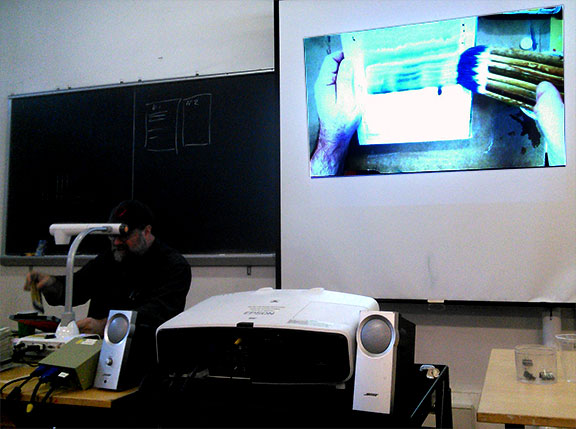
George adding the watercolor wash
Don’t let the wash dry completely. When the pools of the wash are even and the wash is not quite dry, you can establish the white by pulling out the color. Use a clear water brush on the wash to pull the wash back up. George likes to start with the head and use that as a proportional measurement for everything else. He doesn’t draw underneath because it feels like a coloring book. To get the white areas really bright, lay down the water and let it sit before wiping it away with a paper towel. Remember you need to preserve the plate finish, so don’t rub too much.
At this stage and painting in general, George explained, “it’s not about details; it’s about shapes.” Detail typically means the drawing is not working and you are trying to explain it; or you don’t know what you are doing so you use eye candy to hide it. This is not to say that artists with a detailed style necessarily fall into one of these two categories, but to be aware of these pitfalls. George finds detail to be busy work that he doesn’t have the patience for. In comics particularly, you want people to pay attention to the story, not the art.
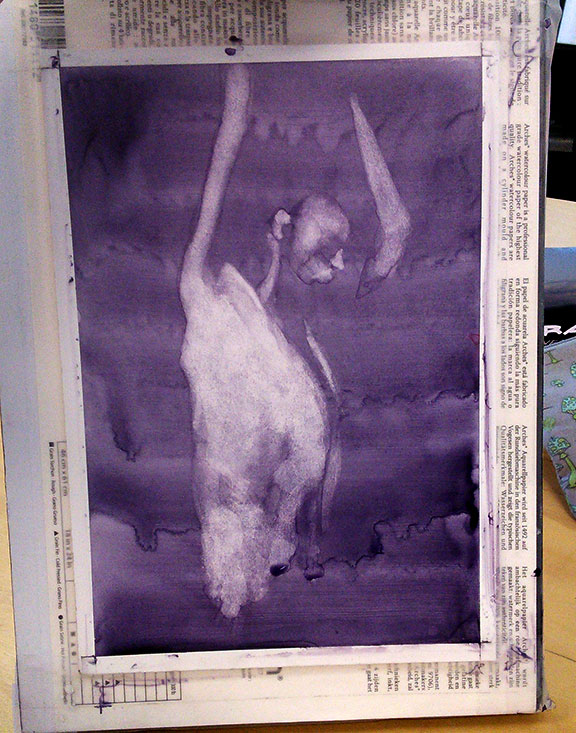
Shapes removed from the watercolor wash
If you are feeling pretty solid with the whites you have set up, you want to start adding darks. George warns to be careful not to put your darkest colors in too early. The dark colors are unstable with this method and slide around with subsequent washes. When choosing your next colors, remember color and temperature relationship: warms come forward, and cools recede. At this point, George was adding shadows for the ribs and face. Adding colors to bring portions forward and move them back. When adding more color, try not to control the watercolor too much; it slops and slides on the China White layer. You have to relinquish control—let it happen and magical things come out, happy accidents. You are adding blobs of color and just nudging them around where they need to be.
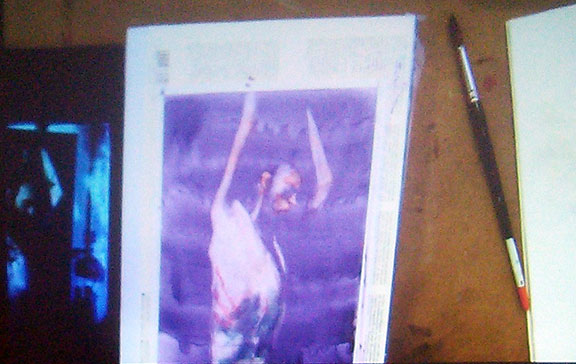
George adding color to the demo watercolor piece
When he was satisfied with the figure, George began to add negative shapes around the figure. He laid down these washes carefully with a soft brush to avoid pulling up the wash underneath as little as possible. You can use a hair dryer to blow pools of water over to the edge and off the tape to mop up with a towel. After your washes are done, you can add ink to the black parts of the image. When the ink is dry or close to dry, you can wash over it again. When George is done, he will often reglaze over the piece with another wash to soften edges and pull it back together again.
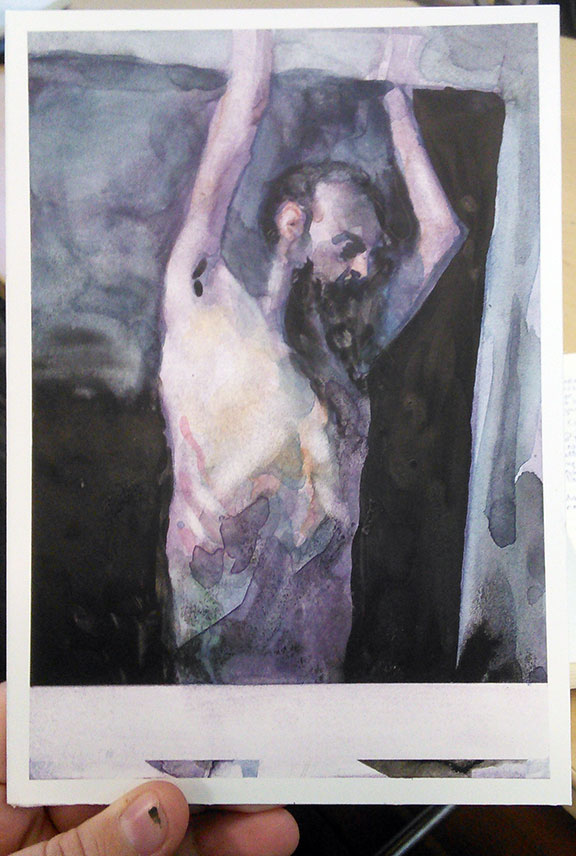
George’s final watercolor
With this method you can also do some interesting things. To recrop the image, just put Magic Scotch tape ABOVE the new crop line, re-wet below the tape, and remove the wash. It will come almost entirely up. When the wash is gone, remove the re-cropping tape and blow dry it bone dry again. Carefully retape at the new crop line. You can use this same method to reapply a straight line. And if the tape wants to rip the paper when you remove it, blast it with the hair dryer on hot to loosen the gum.
Throughout the demo, George dropped some other hot tips. He demonstrated how to plan a haloed drop of watercolor. The halo usually happens when you set down a really wet blob of color. To plan it, paint the area you want to halo with a thin layer of Davy’s Gray. When this layer is dry, anything you paint over it will halo. This trick works with the China White method and traditional watercolors. Another tip was with Pelikan ink, which is not waterproof but is made of color. He places a drop of water on it. Then he lets it sit for different amounts of times before mopping it up. This time difference produces different colors. He used this trick for explosions in Enemy Ace.
George doesn’t work on complete pages any more, just panel by panel based on his layout. This method means he can paint all these images without worrying about messing up what is already done. Then he stitches them together in Adobe Photoshop or ComicArtLife (a free program on Mac computers).
Here are some final tidbits about George that he shared in the demo. His favorite yellow is actually cadmium orange. He uses a Kolinsky sable brush because it lasts forever. It holds a point and is snappy enough for good scrubbing. Now remember, as George says, “Sometimes things don’t gotta make sense. They just gotta look cool. Ya know what I mean?”
This project is supported in part by an award from the National Endowment for the Arts. To find out more about how NEA grants impact individuals and communities, visit www.arts.gov