

 Cartoon Studies on Twitter
 Cartoon Studies on Flickr
 Get the latest news
George Pratt is a comic artist, award-winning painter, writer and photographer. He came to visit The Center for Cartoon Studies (CCS) last week as a visiting artist, and to present at the CARTOONIST DRAWING VETERANS event at the White River VA Medical Center. His most recent projects include a comic in Little Nemo: Dream Another Dream, and Above the Dreamless Dead.
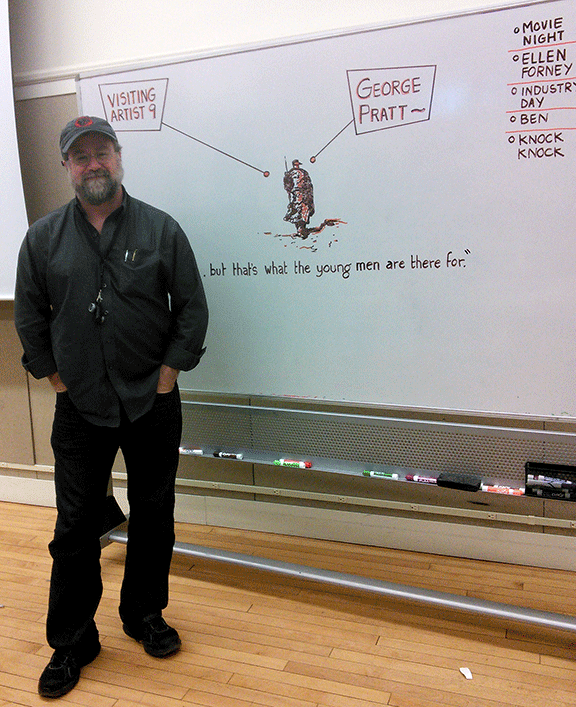
George Pratt after the visiting artist class
Growing up in the 60s, George had two open heart surgeries when he was 5 years old. While in the hospital, he started watching the Batman TV show resulting in his parents buying him Batman comics. He would often read the Creepy and Eerie EC comics drawn by artists like Bernie Wrightson – these felt adult, like he shouldn’t be reading them, and he reveled in it. Then George saw Joe Kubert’s Tarzan and Sergeant Rock and he was blown away. He found Kubert to be a great story teller and artist, using good lighting and interesting points of view (such as worm’s eye). To George, Kubert’s Tarzan is the ultimate comic version. When George was growing up, parents everywhere were WWII vets. He remembers the kids would wear their parents’ gear. This hooked him on DC’s war comics, emotional stories with a point. He was blown away by Barry Windsor Smith’sConan. When Windsor Smith started a press, George bought everything they put out. George had also always liked Rembrandt and Norman Rockwell. George’s dad showed him the impressionist artists, but they weren’t a style he appreciated.
Then came his biggest influence, Jeff Jones. Jones is the person who made George want to paint and opened his whole world. George found Jones’ work in the book, The Studio. In art school, George met Jeff Jones when he was at a comic convention with some art school friends. They showed Jones their stuff, and he invited them to come up to his place to paint. He took them under his wing and showed them how to paint, and all the things they were missing in art school. For example, Jones taught them to base your paintings on shape and the use of neutrals/colorful grays. George and a friend would go with Jones to paint near the Brandywine River. George says he was a “Jones clone.”
In art school, George started Keeper of the Leaves, which he intended to be an all watercolor comic, but he never finished it. Based on the unfinished photos he showed the class, that is a huge loss.
George’s first graphic novel was Enemy Ace – War Idyll about an anti-war hero. He had studied WWI as a counterpoint to the Vietnam war and got hooked. Enemy Ace became his pet project; he kept sketchbooks for it. A friend of his came to his house one day (8 hours away) and asked for all his Enemy Ace stuff. They took it to DC Comics, who said yes to publishing his work. Then as George put it: “the project was real and scary”.
To learn storytelling for Enemy Ace, George took the movie The Blue Max and paused the frame on each camera change to do a thumbnail. He had done little sequential art at the time except some half pages for Heavy Metal. He ended up spending way too much time on the layouts for Enemy Ace because of this lack of experience. He also got to fly in a 2-seater plane. The pilot was barrel-rolling and taking George through his paces as George white-knuckled his camera. George also made model airplanes to photograph, painting them gray so they photographed better.
To find his main character for Enemy Ace, George started haunting nursing homes. He found one, but the gentleman had PTSD and couldn’t talk about the war. Somehow George found another guy on the street who eventually caved and played the part. He was a tiny man but had amazing on-screen presence. Later, No Man’s Land, an Enemy Ace sketchbook, was published. This book is essentially the material with which he sold Enemy Ace to DC. George carries a sketchbook everywhere he goes. His philosophy is to draw everything and anything. 99.99% of sketchbooks are observational drawings. He doesn’t start with pencils; he just dives in. His advice is to just put down the line and live with it. If you make a mistake, start over. He liked sketching people on the subway in NY because you only get a minute before someone moves. He will often freeze frame movies and treat them like life drawing. Movies have great acting, lighting, action, and costumes. He will draw the character as fast as possible. In France, he drew the landscapes speeding by on the train.
As a photographer, George started out with a utilitarian purpose – reference shots for his paintings. However, photography became more important to him after a rough divorce and driving too far to see his kids; it was an aid to capture moments with his children. He began experimenting with new styles and techniques, such as multiple exposures on his iPhone. These photos began affecting he how approaches painting.
As a large part of his talk, George discussed his influences. George has a lot of influences from comics.
- George’s father was into the Sunday funnies, so he found George Herriman’s Krazy Kat through him.
- Roy Crane was another Texas boy. Crane was constantly messing around with format.
- Milton Caniff of Terry and the Pirates possibly also influenced Bernie Wrightson.
- Alex Raymond impressed him by working on both Jungle Jim and Flash Gordon.
- George didn’t become a fan of Will Einser until he read the first Spirit book. He lapped up those comics as fast as he could.
- Harvey Kurtzman, an American cartoonist and comics editor, was an acquired taste for George. He didn’t get into Kurtzman’s work until after graduating art school.
- Originally, he got Robert Crumb comics from his older cousin. His parents would have had a hissy fit had they known what he was actually reading.
- Hal Foster’s Prince Valiant always had the best squid pages.
- Jose Munoz was a master of black and white. All through stories that he drew, Munoz would add little sequential stories in the background. Munoz would walk to a coffee shop and watch the crowd. When he went back to the drawing board, he would add those stories into the panel backgrounds. These scenes were not part of the script.
Of course, he has found inspiration in the spectacular comic work from around the world.
- Bruce Bairnsfather, a British cartoonist, was a captain in the British Infantry during WWI. He started drawing comics for fun while on duty and sent them to his family back home. His family then sent them on to the local newspaper where they were a huge hit.
- Alberto Brecciawas a Uruguayan-born comic artist and writer in Argentina. He was an incredible artist, always trying new stuff. Somewhere, there is a video of him inking with a razor blade! Later he did collaborative work with his own son.
- Dino Battaglia, an Italian comic artist, was influencing European artists in the 20s. He worked on things like Edgar Allan Poe stories.
- George’s favorite work from Jacques Tardi, a French comic artist, are his WWII stories.
George’s influences are not limited to cartoonists. Many classical painters such as Monet and Rembrandt are also counted among George’s influences.
- Edwin Austin Abbey didn’t start painting until his 30s; prior to that he was a pen and ink guy.
- Howard Pyle was the father of American illustration, a real pen and ink guy. Normal Rockwell referenced Pyle’s work. As a writer, Pyle also rescued dying fairy tales such as Robin Hood, and King Arthur.
- In WWI, Harvey Dunn was one of one of eight illustrators on the front lines. Thager was instrumental in designing camouflage patterns during WWI.
- He could stare at the Reader’s Digest novel illustrations by Noel Sickles and cover illustrations by Robert McGinnis.
As a photographer himself, he has photographers who influence him. Robert Capa was there on D-Day. He took 7 or 8 rolls of film, but his assistant put them in a cabinet and all but one burned up.
George is still hard at work drawing. His books are available in the Schulz Library.
The following are portraits of George by some current CCS students.
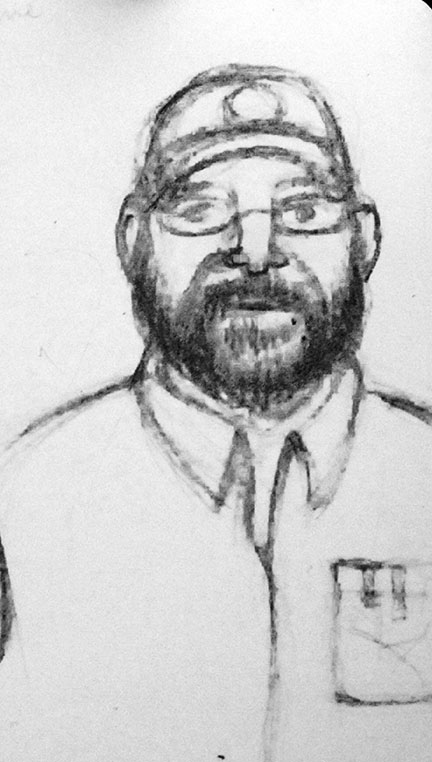
Portrait by George of Sandi Getbamrungrat
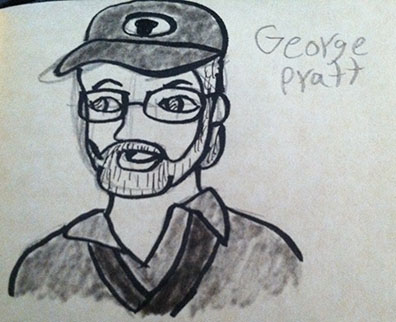
Portrait of George by Alex Karr
This project is supported in part by an award from the National Endowment for the Arts. To find out more about how NEA grants impact individuals and communities, visit www.arts.gov