

 Cartoon Studies on Twitter
 Cartoon Studies on Flickr
 Get the latest news
Sarah Smith, Book Arts Workshop Special Instructor, introduced students from The Center for Cartoon Studies (CCS) to the Book Arts department at Dartmouth where they do letterpress, binding, and books as a form. The department started in the 1930s with a focus on letterpress, book design, and illustration techniques of that era, such as lithography. It was restarted in 1989/90, and this year they are celebrating their 25th anniversary. Dartmouth is located near to CCS in Hanover, NH.
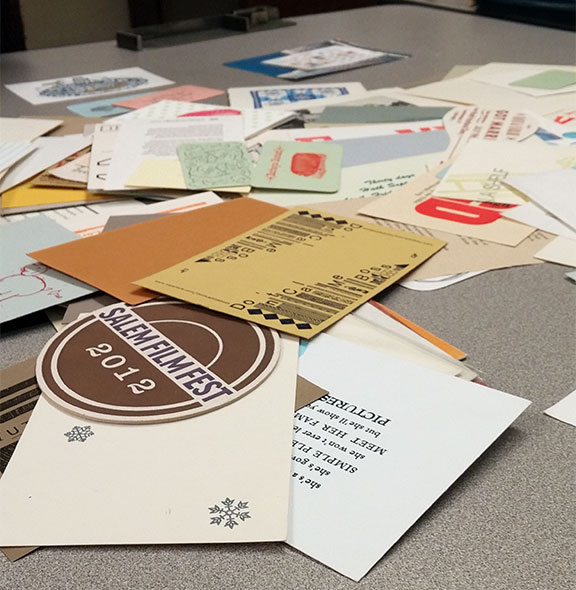
Sarah provided many samples of letterpress.
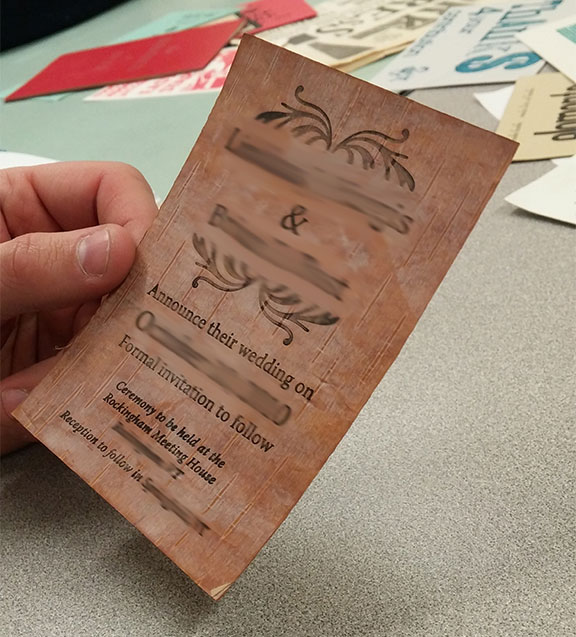
With a letterpress, you can print on unusual material such as actual birch bark
CCS students were given an introduction to running the letterpress machines so that they can return during open hours to work on their own projects. Sarah started with an introduction to the block of text, which needs to be an even rectangle of metal. The letters and spacers have to be nice and tight so there is no wiggle room. It was described to everyone’s horror and humor that the letters can’t feel like loose teeth; this is truly the perfect description. The wooden pieces around the text that help hold it in place are called furniture.
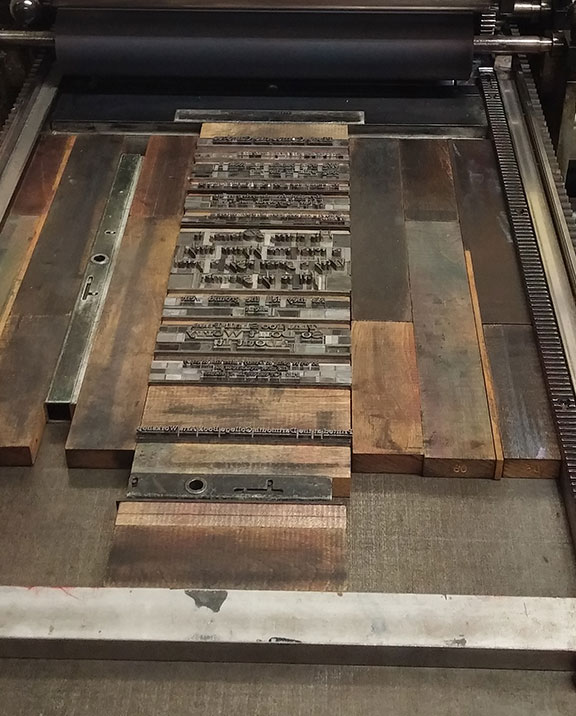
Completed block of text from the first group.
Then the students learned about slugs, which are 6 pts thick, and leading, which is 2 pts thick and goes between lines of text. These pieces create the scaffolding around the text. The width of the text is measured in picas, so the slug and leading need to be the width of the text.
The text is made up of tons of little letters. They are kept in boxes that are all laid out the same; it is like learning a new keyboard layout instead of Qwerty or Dvoark. Oddly enough, the letters ‘J’ and ‘U’ were added to the alphabet after the first printing press, so they are in unusual spots in the box.
Each group, there were two, made up their own text to layout and print together. Each student got to pick their own fonts from the available sets. They had 30 pica lines to layout text within. It might seem mind boggling to layout text that is backwards, but Sarah explained that you just work left to right on your composing stick and follow the text as usual. Each letter has a notch on one side (the bottom of the letter) that marks the ‘foot’ This notch helps with layout; as long as the feet are lined up, it all works out in the end. You just can’t think about it too hard.
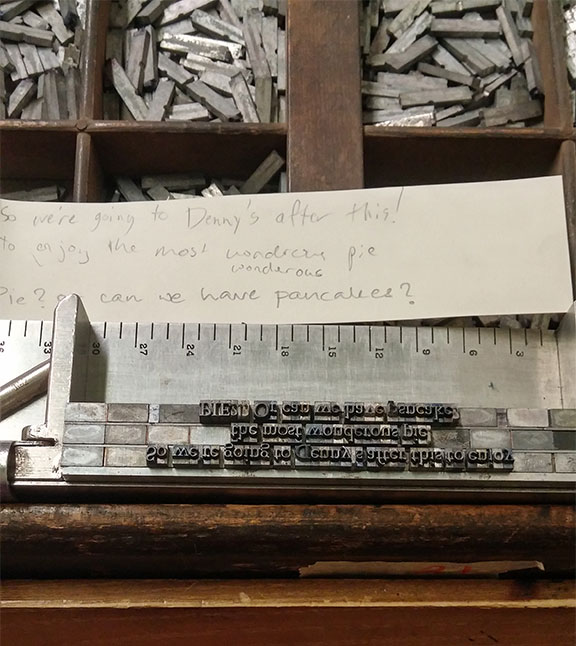
Last lines of type for the first group.
Then each student got a turn running the printing press to print their own copy of the letter block they had made together. After printing was complete, and Sarah had endeared herself to the students forever with some playful straight man teasing, she showed how the printing press is cleaned and had the students put away their letters. She rubs down the letters and then each of the five rollers on the press. The citric oil that is used to clean the press makes the whole place smell amazing.
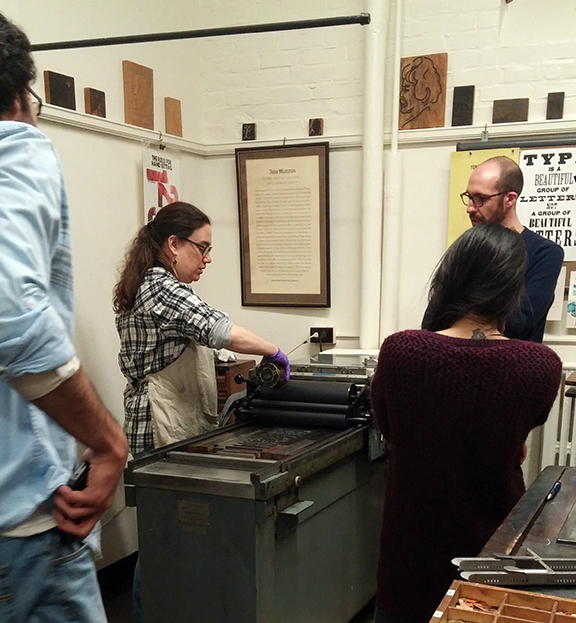
Sarah cleaning the press as Shashwat Mirshra, Sandi Getbamrungrat, and Jon Chad watch.
Another way to print is using a plate that is made from super hard plastic. This can include images and text and is much easier to set up than hand-setting all your type; you can print anything that you can set up on the computer. Sarah had a marvelous example to show from a book she made during her stay at the McDowell Residency. Her book is a beautiful spoof on academia where the text almost makes sense but turns in a most Alice in Wonderland way into almost-connected nonsense.
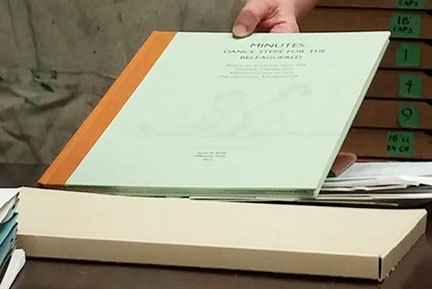
Cover of Sarah’s book.
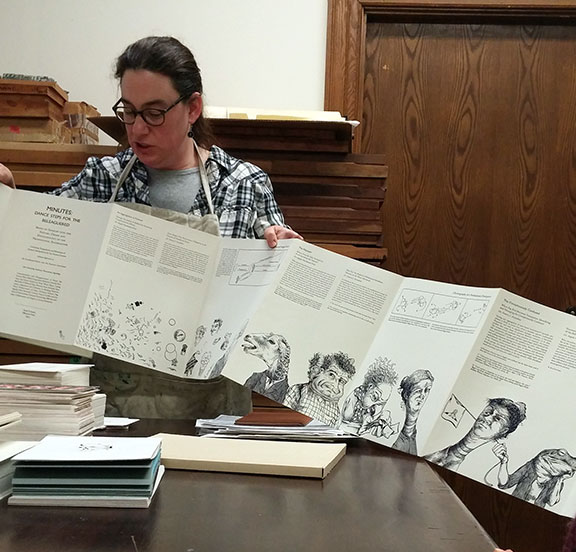
Interior pages of Sarah’s accordion book with her own illustrations.
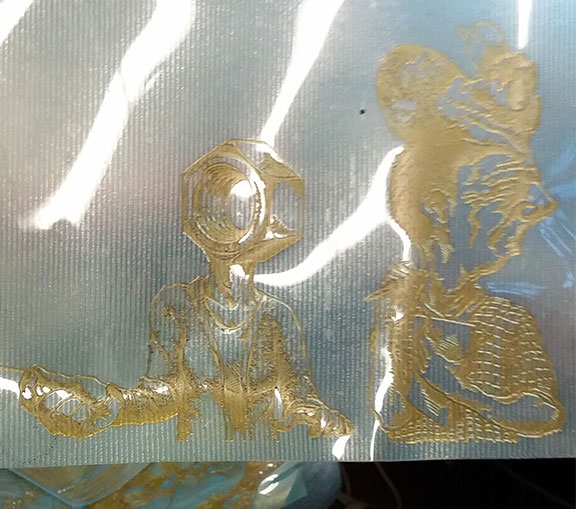
One of many plates for Sarah’s book.
The Book Arts Workshop holds classes on letterpress, bookbinding, and more.

