

 Cartoon Studies on Twitter
 Cartoon Studies on Flickr
 Get the latest news
Scott McCloud has recently come out with a new graphic novel, The Sculptor, through First Second. He is currently on book tour through the US, then Europe. After his talk in Burlington, VT, in February, he made a surprise guest appearance to a class at The Center for Cartoon Studies (CCS). He talked a lot about his process, which has been at least partially digital since the 90s.
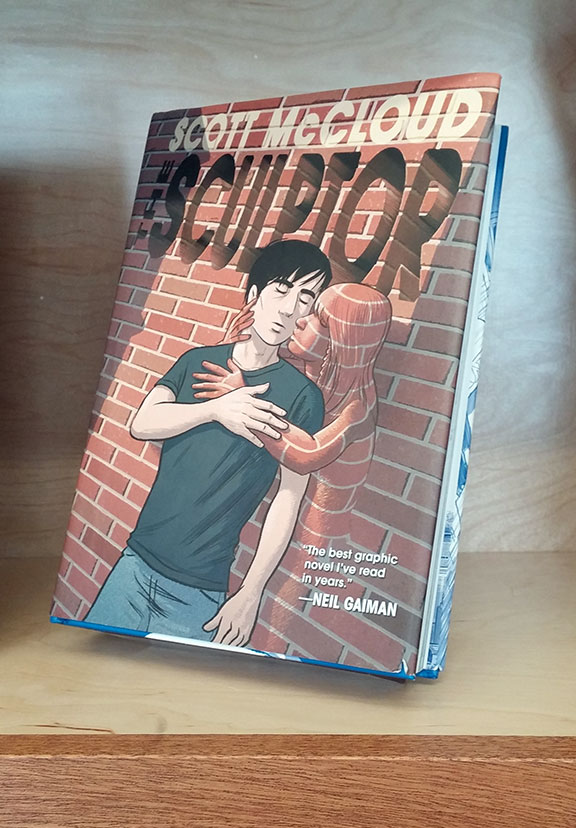
Scott McCloud’s new book The Sculptor on the shelves of the Schulz Library.
McCloud describes a story as a life cycle of desire. A story is born on the desire of the protagonist, and is completed when the desire has been fulfilled, transformed, or denied. Conflict arises from desire. Kurt Vonnegut said that every character should want something, even if that something is a glass of water. One year, McCloud went on a 50 state book tour. He rode with his wife and took notes on what would eventually become The Sculptor. Then years later he came back to it.
He worked with 40 thumbnail pages at a time. He then expands the thumbnails to ink them digitally. He makes the panel borders and text balloons in Adobe Illustrator. Then in Photoshop, he uses the Illustrator file as a layer so he can draw behind the panels and speech balloons. This setup means he never has to erase lines that accidentally got outside the borders, which saves on cleanup time.
In Photoshop, he also has the most impressive action list ever created. Hundreds long and color-coded, he made them so he spends less time looking at his tools and more time looking right at his art. He has layers for the foreground, background, contour lines, and hatching. Each of these layers can be selected along with the appropriate tool by the simple click of an action.
McCloud is well-known as one of the first adopters of a digital workflow, learning to ink on the computer as soon as it was feasible. He could see it was the wave of the future. In regards to his files, the students were interested to learn he usually works at 1200 dpi so he can resize and reposition anything as needed. For coloring The Sculptor, McCloud used about 6 percentages of the same color. In addition to the layers for spot black, hatching, text, and so on, this method leads him to about 40 layers per page. And still, for black and one color, his files were only 150 MB per page. By cramming his computer full of RAM, he doesn’t really have problems with lag.
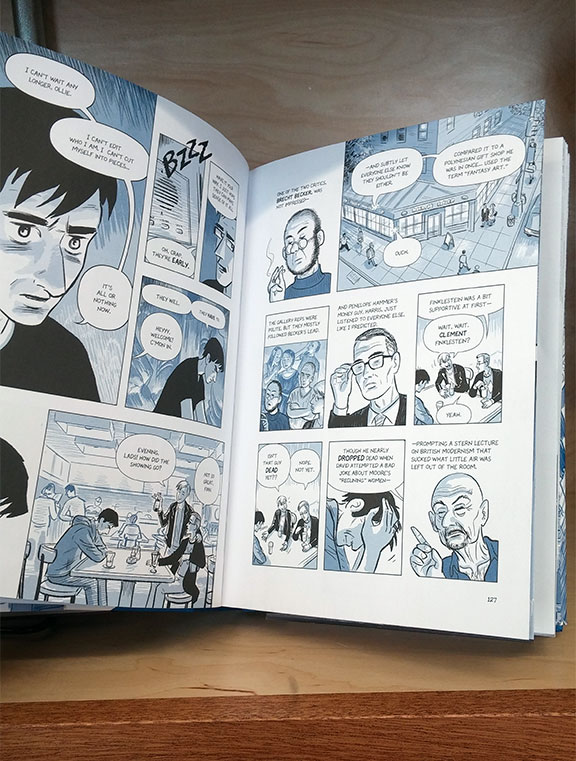
Random pages from The Sculptor by Scott McCloud.
As much as McCloud likes the use of full color, he doesn’t feel he has enough control over it to make it do what he wants. But instead of just black and white, he likes the use of the secondary color to control form. The second color allows the reader to instantly see what the line work is describing. He said the line work is like the wires, and the color is the tissue. Darker colors are like heavier cloth and need heavier wire to be held up. When McCloud had to choose a spot color for The Sculptor, he chose Pantone 653, a grayish blue. He was very thoughtful in his choice of color. He felt that teal has been over used, and purple would have been too dramatic. He wanted a color that gave the feeling of cool detachment.
Through First Second, McCloud was excited to work with an editor, Mark Siegel. This workflow required a lot more work on editing and revisions, but McCloud found it very worthwhile. He got aggressive and useful feedback that helped him wrangle the story, but still allowed him to feel in control. The Sculptor went through 4 rounds of editing. All these edits helped him find the story and excavate it, removing all the extraneous material. At 500 pages, it took McCloud about a year to complete the first draft, turning a 3-year project into a 5-year project. But McCloud and Siegel feel that the extra time was worth it to massage the story into a graphic novel to be proud of.
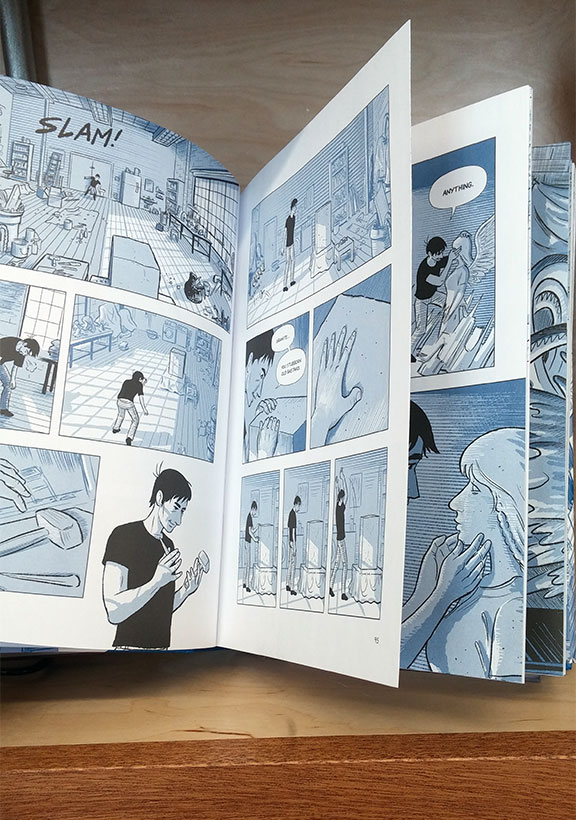
Random pages from The Sculptor by Scott McCloud.
McCloud’s book tour as scheduled by his publisher, First Second, took him to 14 cities in 16 days. McCloud laughed and said he was just getting started. McCloud is a well-known speaker about comics and graphic storytelling. I first saw him speak at a technical writers’ conference in Portland, OR, on the comic he made for Google Chrome. He has no representative to set up his speaking engagements. Someone calls about an proposed event and he schedules more events that are on the way there and back. His book tour is filled in with paying gigs that he lined up after he had the First Second tour schedule.
The Sculptor is out now and available online and at your major comic book retailers. You can see more about his current book tour on his website.

