

 Cartoon Studies on Twitter
 Cartoon Studies on Flickr
 Get the latest news
Luke Howard (’13) is currently the co-teacher and program assistant at The Center for Cartoon Studies. As anyone at the school would tell you, the titles do not do his hardwork justice. At TCAF, he released his first published book, Talk Dirty to Me, with Adhouse. More recently, his second published book, Our Mother, was released through Retrofit. I interviewed Luke in the Schulz Library to discuss his comics like and his new comics. What follows is the edited interview.
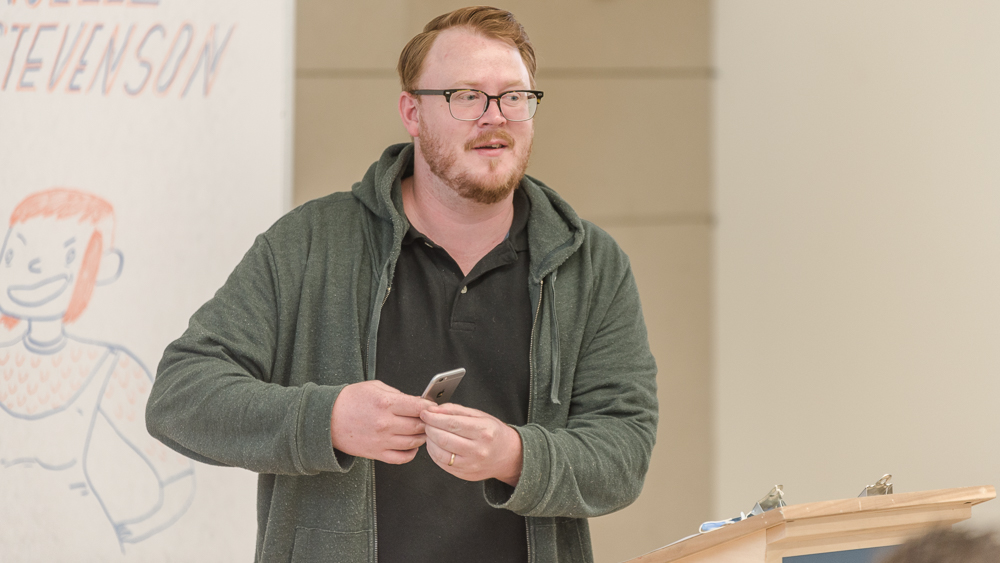
Luke Howard being so Howard.
A: So my class was the first class (Class of 2016) that you were a teacher for (in Publication Workshop)?
L: It kind of happened in stages. But your class is the first class I full-on taught for (in 2014). I was sort of TAing for Jon (Chad) for a year before that. But it was kind of like I was officially the co-teacher for your year.
A: OK. So who was your thesis advisor and why?
L: My thesis advisor was Joe Lambert (whose book I Will Bite You happened to be on the table at that time). It was for a number of reasons. One being that I’m just kind of obsessed with him as an artist. I think he’s one of the best comics creators of our generation. Another reason being that he was local. He’d been through the process, so I knew that he’d have insight how to get through thesis year. And he was somebody that I randomly emailed when I was considering whether to come to the school. And his honesty when it came to both the pros and cons when it came to CCS gave me insight into how I think he would approach being a thesis advisor. That he wouldn’t pull his punches, and he’d offer actual useful criticism.
A: So if you could have picked any cartoonist living or dead as your thesis advisor, no limitations, who would you have picked?
L: Well, I’m a firm believer in not actually choosing too big of your heroes. Like my big heroes being someone like Chris Ware or Seth. I think it’s unwise to choose them as advisors. But in the dead realm, I think I would choose George Herriman. Krazy Kat. I’m just kind of obsessed with him as a cartoonist, but also just Krazy Kat in general. How he tells stories. And the kind of disjointed way that he tells them. I’m really interested in basically that kind of storytelling. That not everything needs to make sense for it to be a good story.
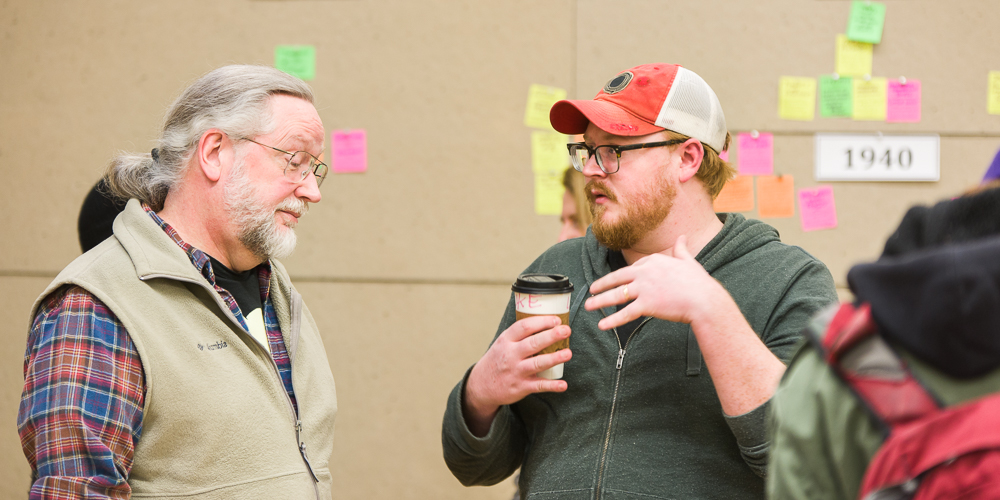
Luke with Steve Bissette.
A: So I know in your thesis, you did a different style (of art) for every story. Have you narrowed down your style, or are the two books that are coming out this year in different styles?
L: They’re different, but I think I’m starting to see more common threads as time goes on. I’m noticing that there’re visual tics that come out when I’m not thinking about it. Certain ways that I pull a line. Or where I realize that I’m doing this more out of muscle memory and less out of a stylistic choice. So I think I’m definitely on the path towards finding my specific style or voice or whatever. But I think it’s still got a ways to go.
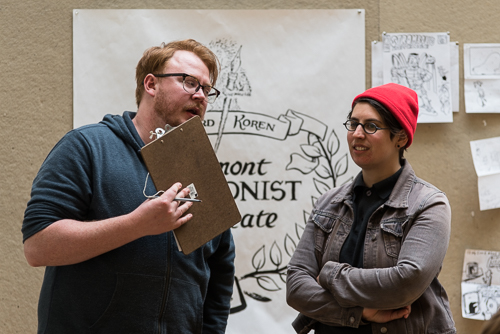
Luke with Sophie Yanow, fellow for 2014-15 and graduate of the Class of ’16
A: So Talk Dirty to Me is purple and orange?
L: Haha. It’s blue and pink.
A: And how’d you pick your colors?
L: Originally it was just the gray scale. Like when it was first published as just part of the Maple Key anthology. And I had no intention of going beyond that, like adding a tone or whatever. But then when I hooked up with Chris Pitzer and Adhouse, I had been playing around with the idea of self-publishing it, so I had done a version that had tone, and it played around with color. And then it was designed to be like bright neon green. So it was gonna be like this bright neon green with blue line art.
A: So kind of like I Will Bite You.
L: Yeah, some crazy vibrant color. But then Chris and I kind of were passing back and forth different color palettes, and we kind of settled on really liking the blue and pink, especially because it kind of had a gender context to it that I think added to the story. That was sort of Chris’s thought, like, blue and pink, that’s sort of like male and female, and it’s kind of about the sexual relationships between men and women.
A: But you didn’t use it to color code characters, like in that book . . . Mazzuccheli’s. . . .
L: Asterios Polylp. No. No. It’s a much simpler approach to color.
A: It’s just like black versus tone.
L: Yeah, basically, like, the line art color and a tone color.
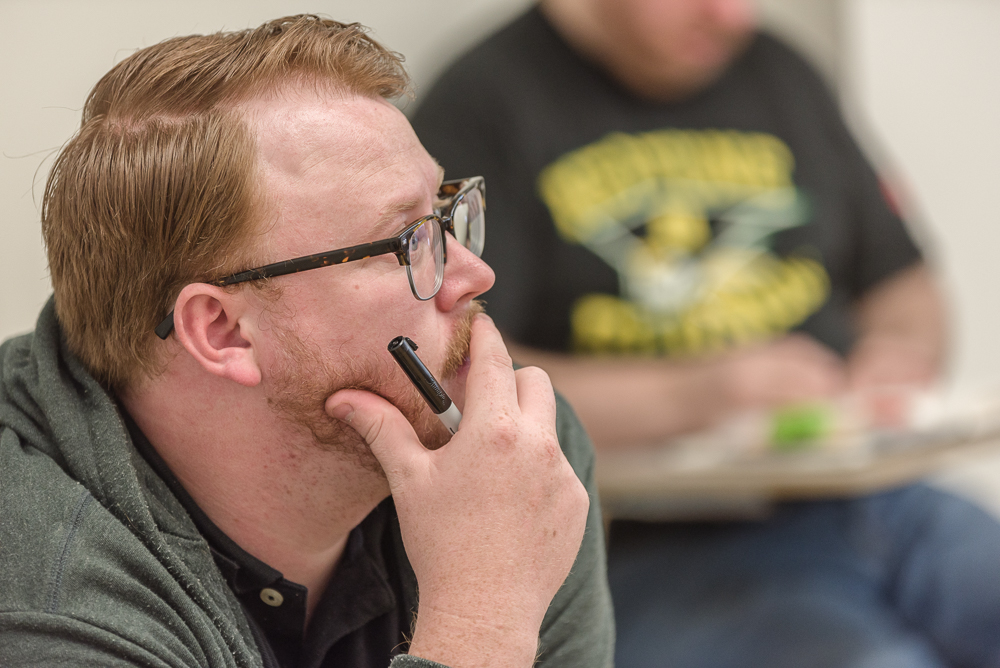
Every once in a while, Luke has a serious side.
A: So I know it’s way more expensive to self-publish color. Why were you going to make the expense to self-publish in color?
L: ‘Cause I have a really hard time thinking in black and white. I hated drawing it (in b/w). Things don’t really feel complete until color is involved. ‘Cause I feel like I do a lot of story telling in the color phase. Like a lot of intention and meaning kind of comes to fruition in the color phase that I don’t even realize was originally there. I’ll start coloring something, and new kind of meanings will start popping out to me. Like if I color it this way, I can bring new meaning to the topic.
A: So given the choice, you would not do black line work with color. You would always do color on color.
L: Or I would treat the black as it’s own color. Kind of like Sophie Goldstein in The Oven. It’s black and color, but it’s really about how those two colors mix.
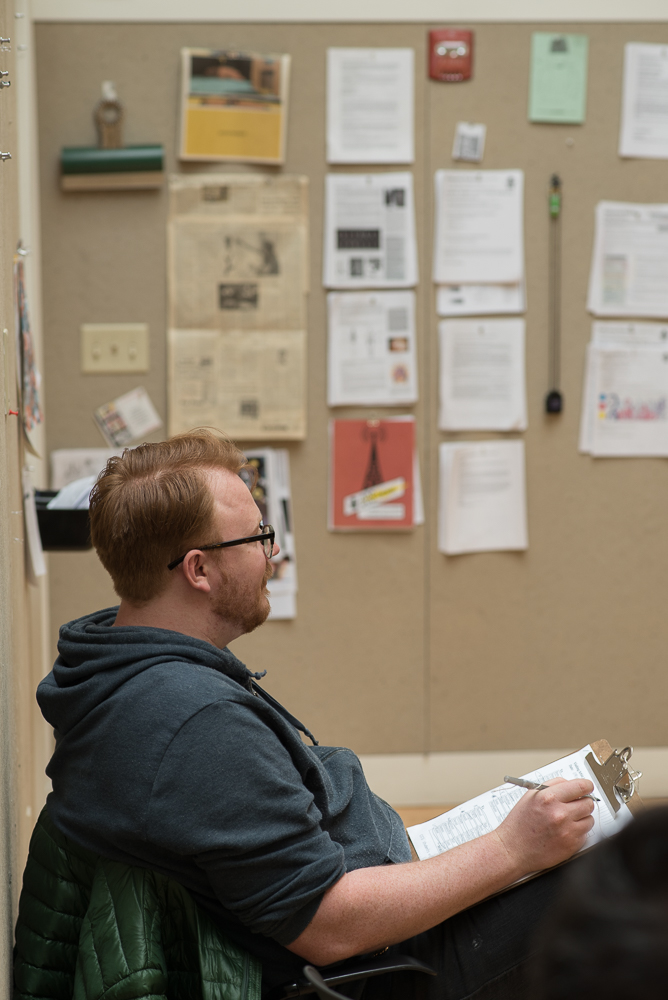
Oh, no. It’s his serious side again!
A: What’s your favorite thing to draw?
L: My favorite thing to draw. . . .
A: ‘Cause I can’t think of any themes off the top of my head.
L: Yeah, like you think of Tillie (Walden), and you think of giant people or cityscapes or something like that.
A: Yeah, that’s exactly my question.
L: I don’t know.
A: Well, one of my favorite stories from your thesis was the goldfish.
L: Ah, yeah. Well, definitely childhood is like probably my biggest thing. Or the thing that I find comes up a lot. I’m noticing that there are specific kinds of narrative devices that come back up a lot, and one is children dealing with trauma. Which isn’t an original thing by any senses, but my own personal issues that I work through in stories. Weirdly, like, a person or two being trapped in some place and trying to get out is another.
A: Sort of like The Junc (White River Junction, VT) for ya?
L: Ha. Yeah, I don’t know. I had this story Trevor that’s a guy trapped with a rabbit in this cabin. And them kind of not getting along over time. And my story for Retrofit has a bit of that as well. Like two characters that are trapped that kind of hate each other. I think that makes sense! I think that’s probably what it’s like in my brain.
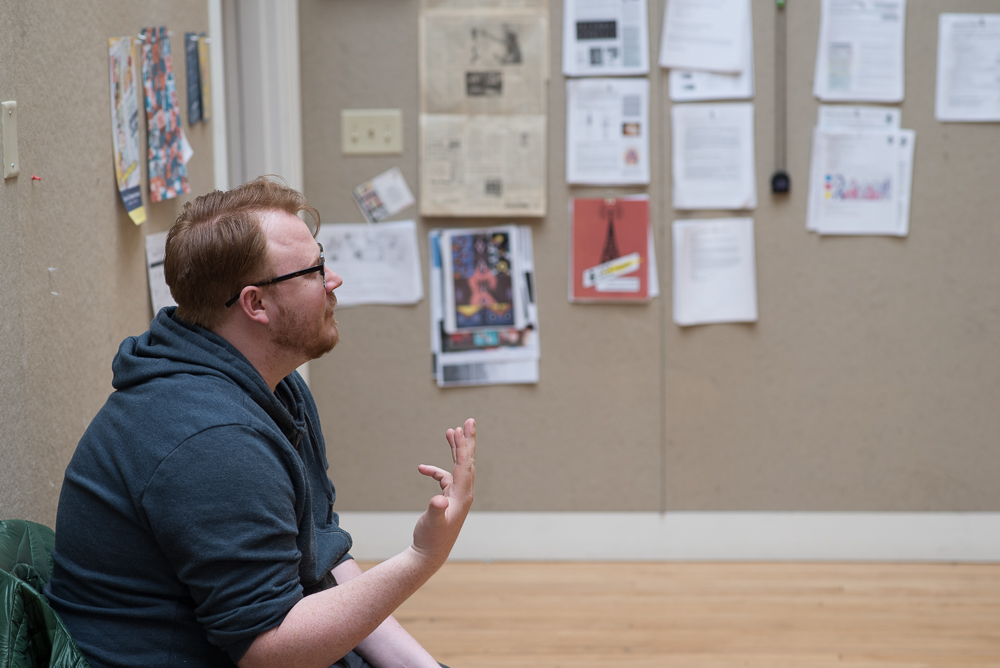
I didn’t think this level of seriousness was possible for the Lukester.
A: Is Talk Dirty to Me your first publisher printed book?
L: Yes. It’s my first story that I’ve done all by myself that’s being published. That has like an ISBN number and stuff.
A: And I guess you’re instantly getting a second book this year as well with Retrofit.
L: Yeah, I didn’t plan that, but I had approached both of them with some pitches, and they both kind of happened. Like, I didn’t expect the Chris Pitzer/Adhouse thing to happen, so I agreed to the Retrofit thing, but then Chris got back and was like, “I’m interested, too.” And I was like, “I can’t so no to either of these.” So it kind of was a little bit of a big watershed moment.
Finally, back to a more normal Luke, teaching with Jon.
A: How finished were the books when they said yes? Because you’d already started on Talk Dirty to Me.
L: Talk Dirty to Me probably could have been finished as it was. It had been done over six chapters through Maple Key, but I wasn’t happy with where it was. So I ended up redrawing about half the story. That’s what I spent most of December, January, and February doing was getting rid of a chapter, changing the whole ending, drawing new pages, redrawing some pages, relettering a bunch of stuff ‘cause I felt like the lettering wasn’t quite up to par.
A: Very smooth. I didn’t notice any bumps when I was reading through it. I never could have picked out a spot where you had edited.
L: I think it was a cool experience to have it released in this kind of serialized way with Maple Key. And then getting the chance to kind of revisit and be like, “How would I make this better?” I think that’s like the normal editing process that happens. You turn it in to an editor, and they say, “Change all these things” or “It would work better if you did this.” But you know, you don’t get that a lot in small press. That is what I’m starting to learn. They just want to publish your vision. But you’re kind of completely in control of whether the story works or not. So kind of getting to visit the story again for a second time and redoing stuff was like my own chance to edit it to something that I actually felt more strongly about.
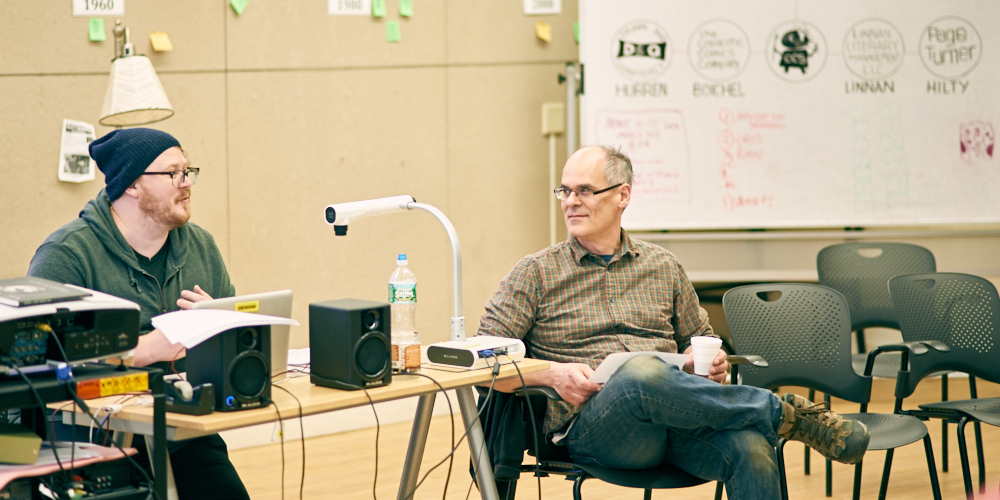
Luke keeps it professional with CCS co-founder and teacher James Sturm.
A: So would you want to do that again, where you do the whole story and then submit that to a publisher, and then when they say yes, go through and re-edit. ‘Cause that’s quite a long period of time, typically.
L: I mean, I think ideally you would just feel like you nailed it the first time through. Ha. And I think that, you know, with stuff like the Retrofit story, it’s just kind of like I do it, and then I turn it over to them, and it’s just kind of how it turns out. There’s not gonna be a round of editing or anything. But I do think that it definitely has made Talk Dirty stronger. So if there was a way to build that into the process, I think that’s smart. Even though I hated it. It’s hard to go back and be like, “I’m going to throw away this huge chunk of pages that I just spent like 3 months on.” In film, they always say you’re not succeeding unless you leave blood on the cutting room floor. Which I always just hated. The idea. But it’s true.
A: Well and ideally, with comics, you would do it in the thumbnail stage.
L: Right. And I don’t thumbnail. So that’s probably a burden I put on myself, to do the editing after.
A: Hahaha. You sweat it out and then clean it up. So is the art for the Retrofit book done?
L: It’s almost there. . . . It’s due May 7 for the art work.
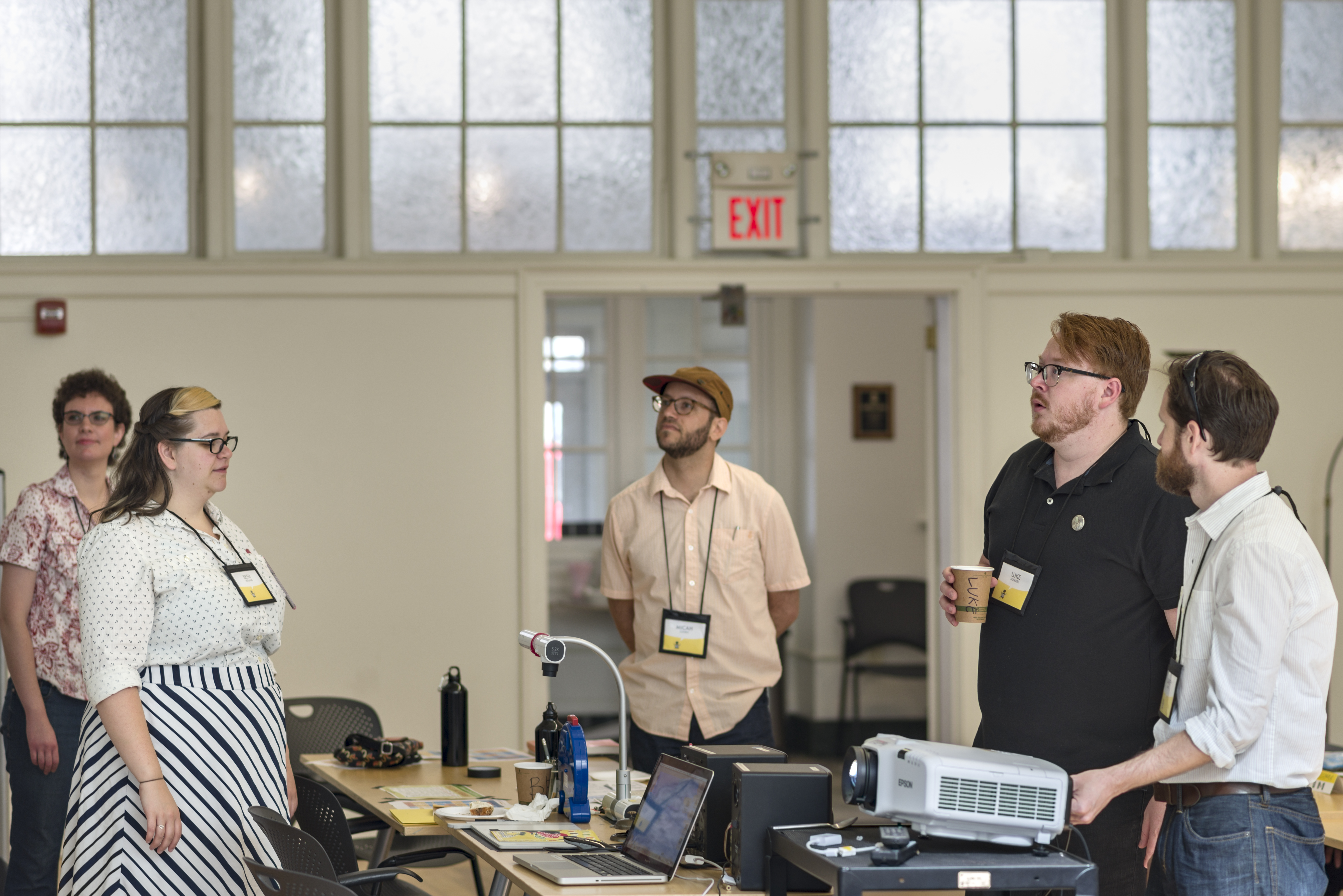
During the summers, Luke teaches workshops with Beth Hetland. You would never guess the energy they bring from this photo.
A: That was different from Talk Dirty to Me where you had the whole thing and then went back and edited it. With Retrofit, you hadn’t done any of it yet?
L: Yeah. Retrofit does things in a very interesting way where they’re kind of just like, “We like your stuff. Would you like to do a story?” And then I came back saying, “Sure, what do you need to know about the story? Do you need to know the size, or how long it’s going to be, or whether there’s color or not, or what it’s called, or what the story is about?” And they were just like, “Nah, just send us it when you’re done.” So there’s a lot of faith, I guess, that what the artist delivers is going to be something they’re cool with publishing.
A: I mean, I guess that makes sense. They’re like, “I love your work. Make a book. We’ll help you put more of your stuff in the world.”
L: Right. It’s like the opposite of handholding.
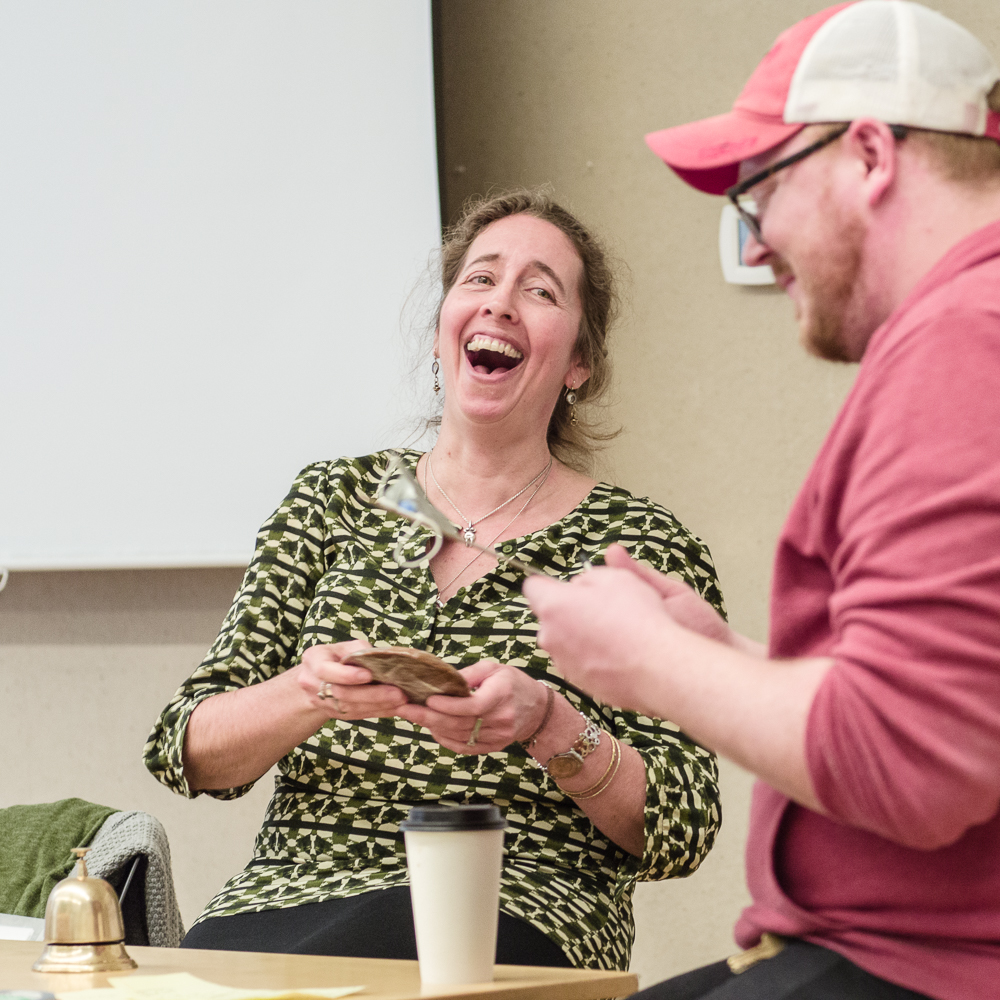
Jen Hayden wasn’t fooled by Luke being serious for an instant.
A: And you already have the Retrofit subscribers who didn’t know you are now going to be new fans. I’m assuming.
L: Right. Hopefully. But there’s that obvious benefit that there’s some really big names in that Kickstarter that Retrofit did, like Eleanor Davis. My book, I know because of the release time, is going to be shipped along with Eleanor’s book. So there’s gonna be that pressure, but also like, “Well, if they want to look at Eleanor’s book, they’re gonna have to look at mine.”
Here’s Luke being professional again with Michelle, but he doesn’t know Michelle’s secret love of silliness. (It’s not that secret.)
A: So you work full time for the school? Or almost.
L: Yeah, because I have two jobs. So half of my full-time job is all the visiting artist and design stuff and all that. Basically the program-coordinator side. And then there’s teaching, which kind of fills out. So when you put that all together. . . .
A: Cool. So how many hours a day do you typically get to draw. Or do you draw like one day a week?
L: I usually draw all weekend. I find it really hard to draw in the week. I always say I’m going to. Like when work is over, I’m going to do a page. But that rarely happens. When I’m writing something, I’m usually writing constantly, throughout the day in my head. And so in the writing sense, I can do that at any time. But when it comes to actually pumping out pages. . . . You know, Friday, Saturday, Sunday are my days off, so I just kind of load it all onto those three days.
A: So you do 40 hours a week over 4 days?
L: Yeah. And part of that is so I can have Friday, Saturday, Sunday. But I’m starting to realize it’s not a sustainable model. You gotta have at least one day off. I mean, not everyone does. Some people can’t handle not working.
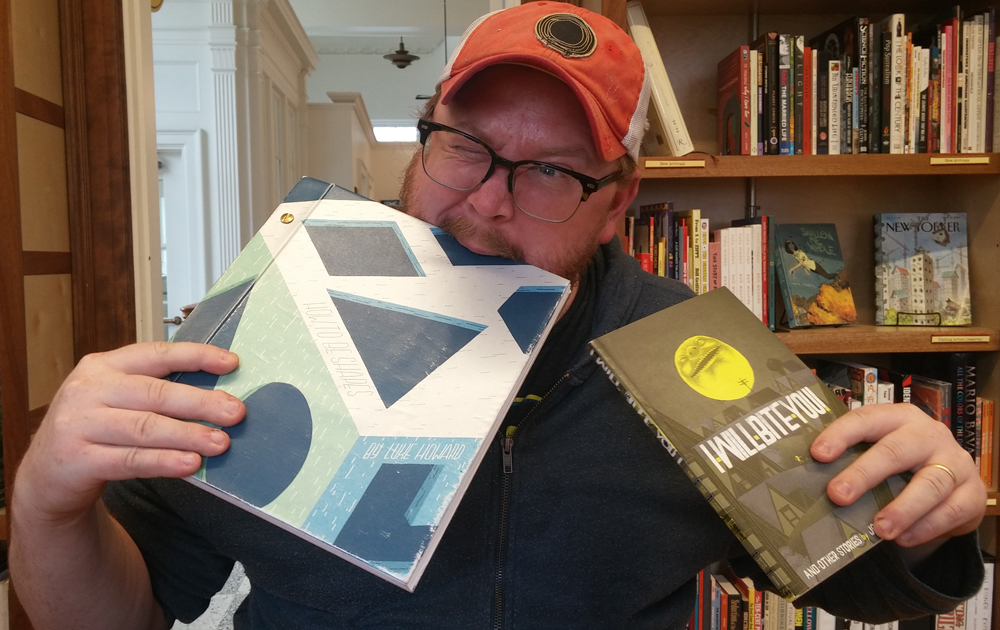
Luke might like his thesis too much.
A: So you’re still working on Our Mother. You’re done with Talk Dirty to Me. Are you already planning your next book? Are you already sending out pitches, or writing, or coming up with ideas?
L: I have a script that’s written for something that I was hoping to put out for CAB. And then I have a bigger thing that I was originally working on for Chris Pitzer, like as a pitch for Chris, before Talk Dirty to Me was on the table. That’s sort of like the kind of next big passion project that’s ahead. But that’s a bigger thing, so I don’t know when I’ll be able to muster the energy again. I definitely feel a strong desire to get back to doing shorter things for a while. I have this silly self-published thing for SPX that’s just completely sloppy and the complete opposite of trying to do a polished, finished thing. ‘Cause I feel like, even though what I’ve been doing is good, I need to do something fun for a while.
A: Goof off time.
A: What would you call your fans? Like Lady Gaga calls hers “little monsters.” And Benedict Cumberbatch’s are called “Cumberb*tches.”
L: Uh. . . . You know, there’s just. . . . I don’t have fans. I mean, I’m sure I have fans or people that like my work, but I don’t think I’ve reached that level.
A: You can still name them. You can prepare for the future.
L: What do you think? Give me some ideas.
A: Lukers.
L: Lukey-Loos.
A: Ooohoo, I like that.
L: I think I like Lukey-Loos.
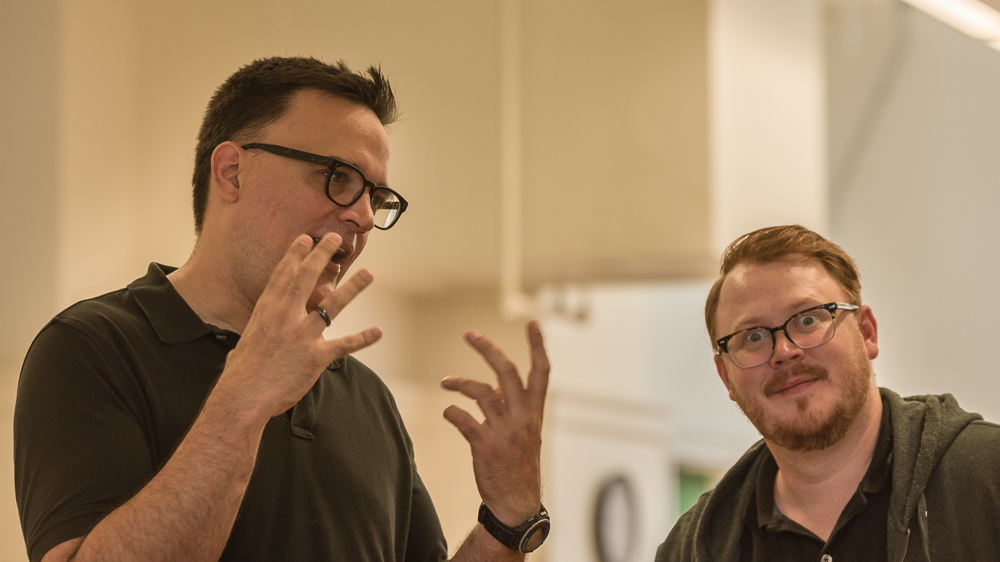
Luke gets real with Dave Humphreys.
A: Ok, final question. In this library, what is your favorite book?
L: Well, I know what my favorite book is. Aw man, and you know, I probably need to change my answer to one of the questions. Definitely my favorite book, which isn’t in this library because it’s at home and I’ve had it at home almost all year . . . even though I constantly get emails from the school being like, “You need to return this,” and I’m like “No, I’m keeping it!” . . . is The Art of Living by Saul Steinberg. It’s just a collection of Steinberg sketches. And right now he is like by far the cartoonist I’m most obsessed with. So he could be another answer to that question where I said George Herriman. But now that he’s popped back into my head, right now he might be the guy. Him or, like, William Steig. I just love them. They are so great.
A: That’s it, unless you have anything else you want to say.
L: Uh, I do want to say that I could not have been more lucky than to have Chris Pitzer as the first person I published with. I think he ‘s just like the right level of laid back but also really, really kind. He’ll like hold my hand when I need it, but he also knows just the right amount. I just think he’s a really strong publisher. And I hope his books continue to do really well. ‘Cause he just has amazing design sense.
A: Yeah, he’s got a nice table at cons.
L: Plus he’s like a handsome Southern gentleman.
A: Ha, what you aspire to be.
L: Some day.
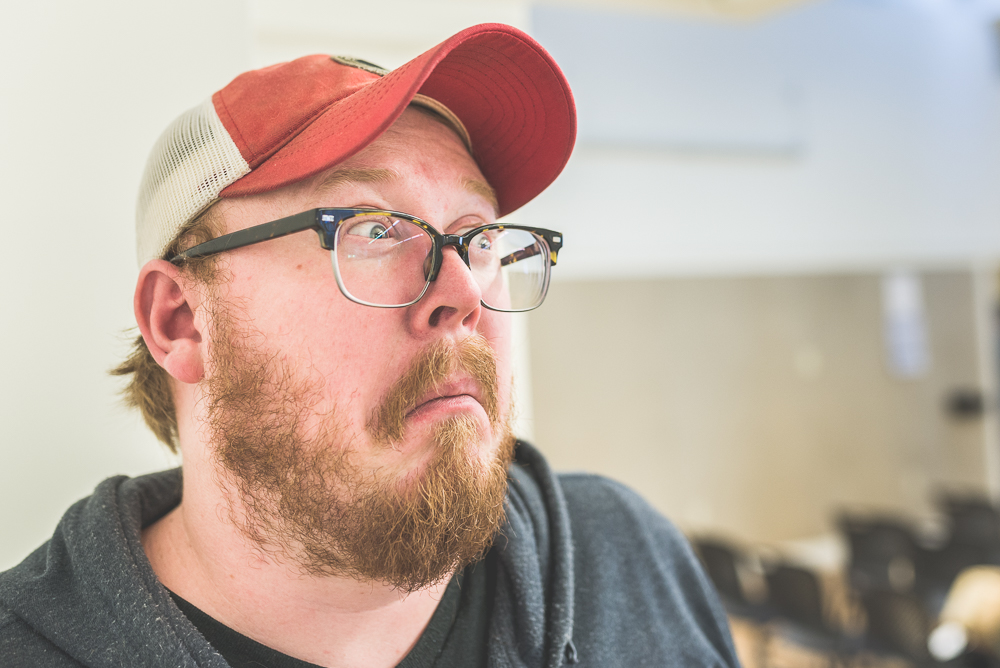
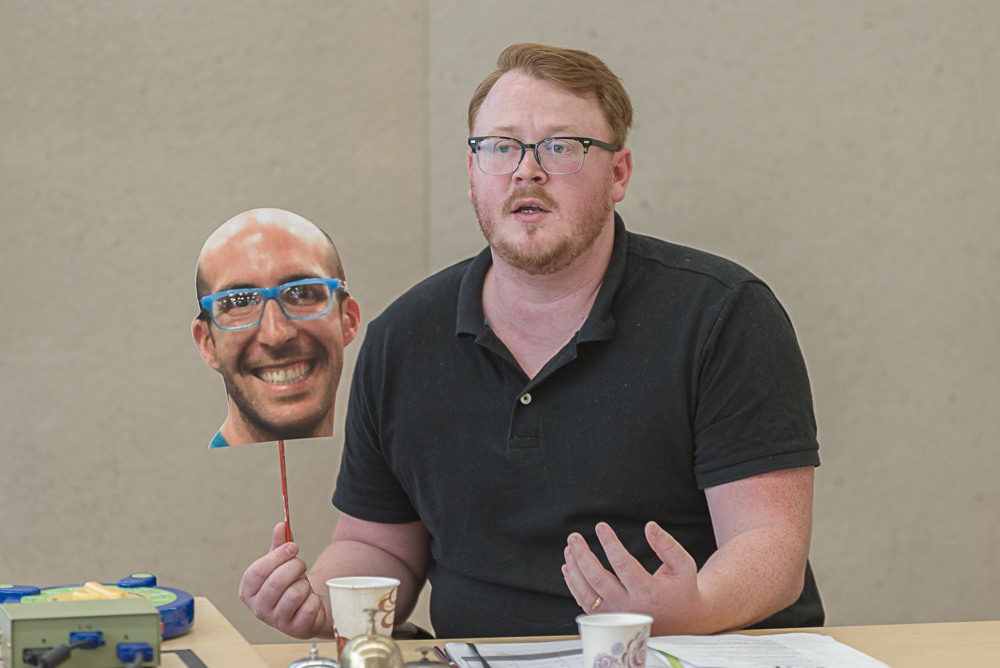
Here’s the Luke we all know and love.
Photos courtesy Abe Olson.

