

 Cartoon Studies on Twitter
 Cartoon Studies on Flickr
 Get the latest news
Brian “Box” Brown is the creator of Retrofit Comics, a small-press publisher, and a cartoonist himself. He has self-published, been published through other publishers, and works often with MAD Magazine.
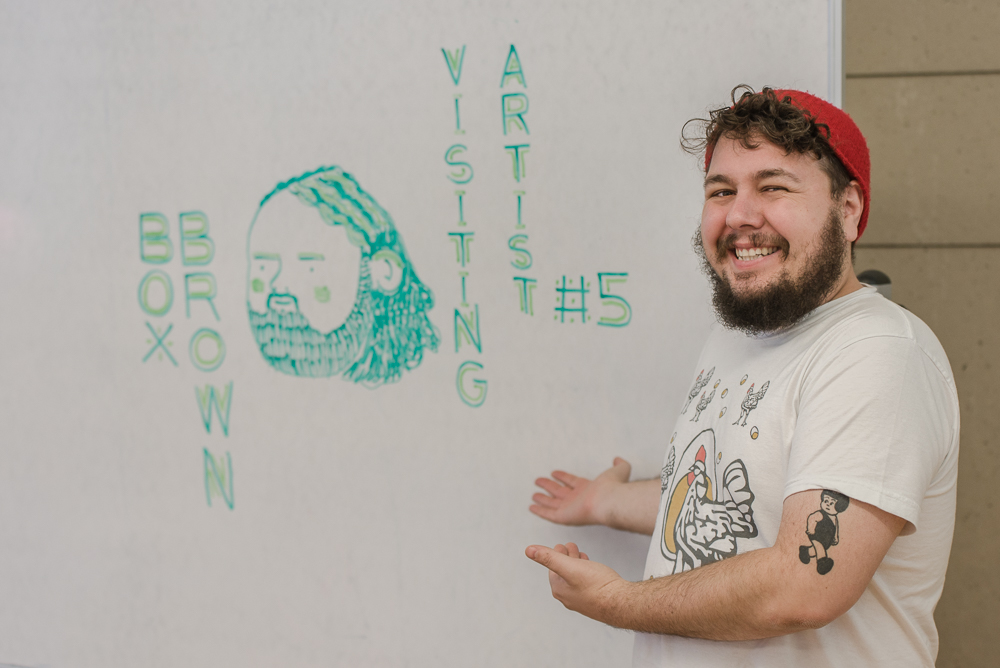
Brian “Box” Brown in front of his name board, drawn by Luke Howard.
While making Everything Dies, Box studied religion to enlighten himself. But eventually, he couldn’t write atheist screed anymore. So he challenged himself to do a mini-comic 2 weeks before SPX. On YouTube, he saw a third-hand story about Andre the Giant, so he turned that into his comic, which sold out all 25. He did another for CAB. And then he just kept doing them. Before he knew it, he had 100 pages of random Andre comics: some real, some fake. Showing them to First Second, they were interested, but Box felt the 100 pages weren’t good enough. So he redrew them to be more factual.
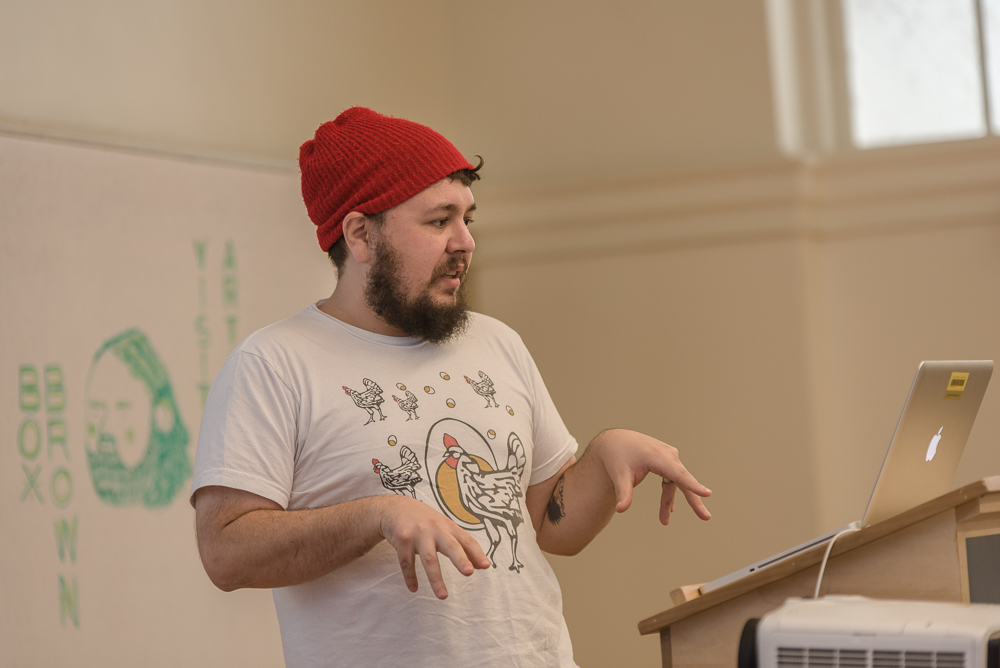
Box tells it like it is.
Despite the success of Andre the Giant (and it could easily have been a flop, he says), Box doesn’t actually recommend graphic novels; they are hard work! He finds it is better to serialize, especially when you are just starting out. It is “folly” to publish once every 5 years. And when you are just starting, your artwork can change a great deal from start to finish. Part of the reason Andre was a success was getting fans outside the standard comics circle. That’s the sweet spot.
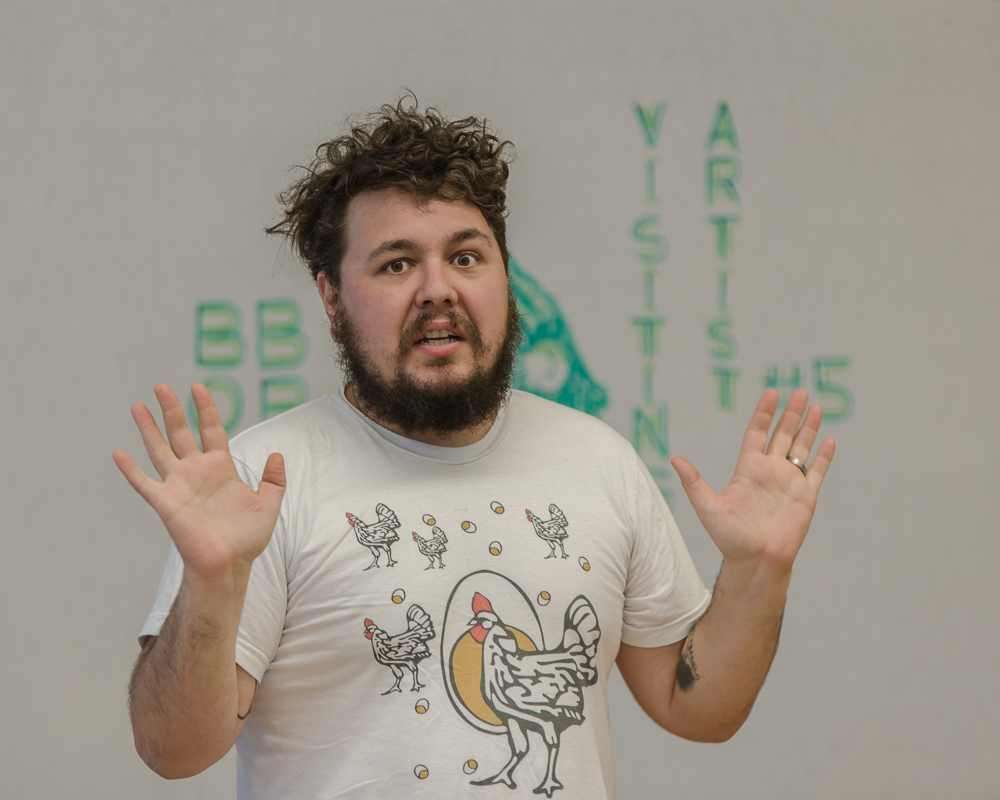
Box doesn’t get it, either.
In creating comics, Box pencils with a 3H and letters with a 5H. He has a ruler and a plastic T-square, which he replaces about once a year, that he uses together for lettering. He uses a Micron 08 almost exclusively (about 10 every 6 weeks). Then he fills with a brush or in Photoshop. When he bitmaps his scans, the pencils disappear, so he doesn’t erase. He also makes great use of circle makers! He draws smaller because the bigger it gets, the fancier the drawing can be. But with comics, he finds it doesn’t have to be slick or fancy; the things that make your style are the mistakes.
-

- J. D. Lunt (’16) is very amused.
-

- Santiago Naranjo (’16) is fairly amused.
-

- Jacob Boussier (’17), Jarad Green (’17), and Laura Martin (’17) agree with the general amusement.
Box had the idea to create Retrofit Comics after the first time he saw a comic on Kickstarter. He was already doing a subscription service for Everything Dies, a method he stole from Alec Longstreth’s Phase 7 and John Porcellino’s King Cat. After self-distributing, Box’s good connections meant he could do the legwork for other people. He emailed his friends and cartoonists he admired to rally them to his publishing cause. 17 people were immediately interested in being published by him.
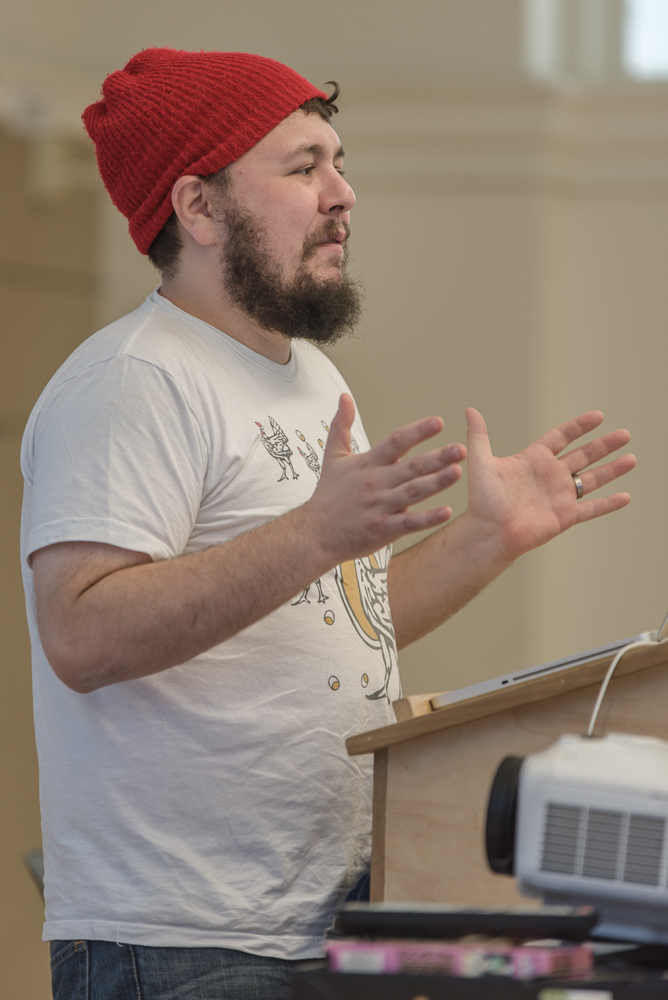
Box explains it all.
But publishing is a tough business. Box was in debt. Just before flopping, Box was contacted by Jared Smith from Big Planet, a comics shop. He wanted to become a partner in the business and help build up the Retrofit brand. Retrofit was in a position Box had never expected: Jared was an actual businessman with storage space, employees, and actual resources. This allows Box to focus on the fun part of the business: working with artists, editing, producing, and being the face of the company.
-

- Emilly Sillars (’17) thinks about the publishing industry.
-

- Laura Martin (’17) is a bit concerned about the publishing industry.
-

- Tillie Walden (’16) is less than concerned about it all.
The editorial process for Retrofit has changed over the years. It used to be that Box would ask a cartoonist to make a comic for Retrofit. But now he asks people to submit. Some of these people want lots of feedback, and some don’t; but he knows and trusts all of them already.

Thanks, Box!
Photos courtesy of Abe Olson.

