

 Cartoon Studies on Twitter
 Cartoon Studies on Flickr
 Get the latest news
Dan Archer, from London, is a graphic journalist and a CCS grad from ’09. He started making comics when he was assigned jury duty and used it to express his feelings of helplessness at a not entirely just system. He was the first student to come to CCS for journalism and his focus has been on US foreign and domestic policy. Most of his work is for non-governmental organizations (NGOs).
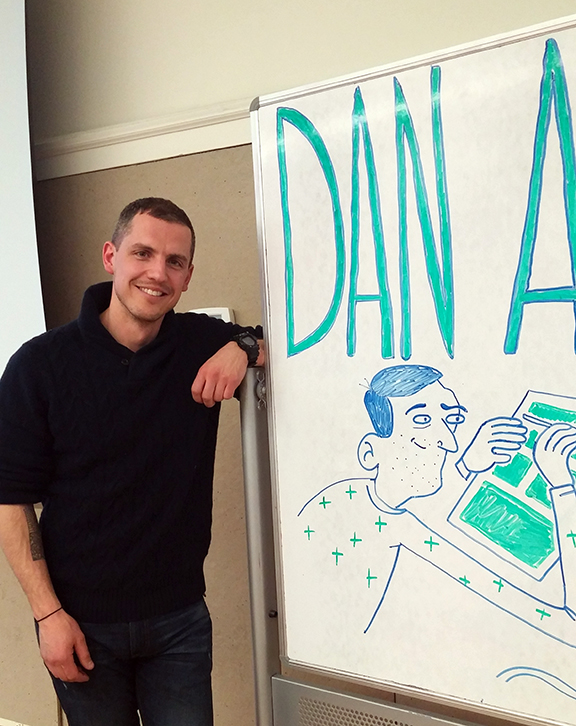
Dan with his visiting artist portrait
One of the questions he often gets is about how he can possibly do objective journalism through comics. Because art is so blatantly personal, there is no way to hide your “self.” As he points out, all journalism is subjective, but comics can’t try to hide that. Comics are a more honest way of telling a journalistic story.
In publishing his comics online, he makes use of the fact that the images do not have to remain static. He uses tools like the Thing Link website to make his comics more interactive. You can use Thing Link to place dots of information on an image to pop up links. He uses these pop ups to attribute quotes, reference sources, and point to further information. He always thinks about how he can best use these tools to their advantage though. For an interactive piece about Michael Brown, he created a virtual “sandbox” world where you can wander around to read eye witness testimony in comic form, view crime scene photos of evidence, and listen to related audio such as witness testimonies from the grand jury.
Throughout his comics career, he has found himself moving from political and national conflicts to more personal conflicts. In 2012, he used Kickstarter to fund Borderlands, an online comic and graphic novel about human trafficking in Nepal. Also in 2012, he published Escape from Alcatraz: The Lone Wolf Breakout, where he specifically chose to focus more on the personal story than the traditional Hollywood story of big action. More recently, he is working on an online virtual reconstruction about the Michael Brown shooting in Ferguson using the Oculus Rift, a 3D display. In a comic about how the International Criminal Court works, he made a comic that you can scroll through vertically, but at some panels, you can also scroll down to see pros and cons about the information. He tried once to draw a complete graphic novel in the field, but after being out until 8 at night speaking to sources and getting references, he found it to hard to draw let alone try to put the pieces into a coherent comic.
In addition to lengthier in-depth pieces, Dan enjoys doing live commentary through sketches. For example, during the election primaries, he sketched single panel comics from quotes. He even attempted an animated gif, but it took 20 minutes, which is too long for live commentary. When he is not doing live commentary, he finds that even light gif work, such as a blinking phone screen, can be enough to bring the reader’s attention back to a dry subject. He often works straight into digital, but nothing beats a sketchbook. When you are out and about, he recommends sketching all the time, straight to pen. Pencil just removes the stakes.
Dan purposefully avoids what he calls “desk jockey journalism,” that is, researching on Google and Skype calling, whenever possible. He finds that going on location is the best way to reach a story. You can exchange ideas with the people involved and write on a personal level. For the Michael Brown story, his options were limited, but he did send the comics he made from people testifying to the person. Because these witnesses are media shy, he did not hear back, which is what he expected. He did want to do his best to provide them the opportunity, though. For tough, in-person interviews, such as after a person has had a traumatic experience, he includes a counselor in the meeting, often submits his questions before hand, and always stops if the person being interviewed begins to look uncomfortable. This is a difficult situation that he handles with extreme care, but also knows that getting their story out in a personal way can remove stigma and help people recover.
Dan is currently teaching journalism at the University of Missouri. During his visit to CCS, the first years completed a journalism assignment, so he participated in class critiques. You can keep an eye on what he is doing online through Twitter and Instagram (@archcomix).

