

 Cartoon Studies on Twitter
 Cartoon Studies on Flickr
 Get the latest news
Ellen Forney, creator of Marbles, is a cartoonist from Seattle, Washington. She visited The Center for Cartoon Studies (CCS) and Dartmouth College in conjunction with the Leslie Center for the Humanities at Dartmouth College as part of CCS’s annual spring Eisner Lecture series sponsored in part through the Will and Ann Eisner Foundation.
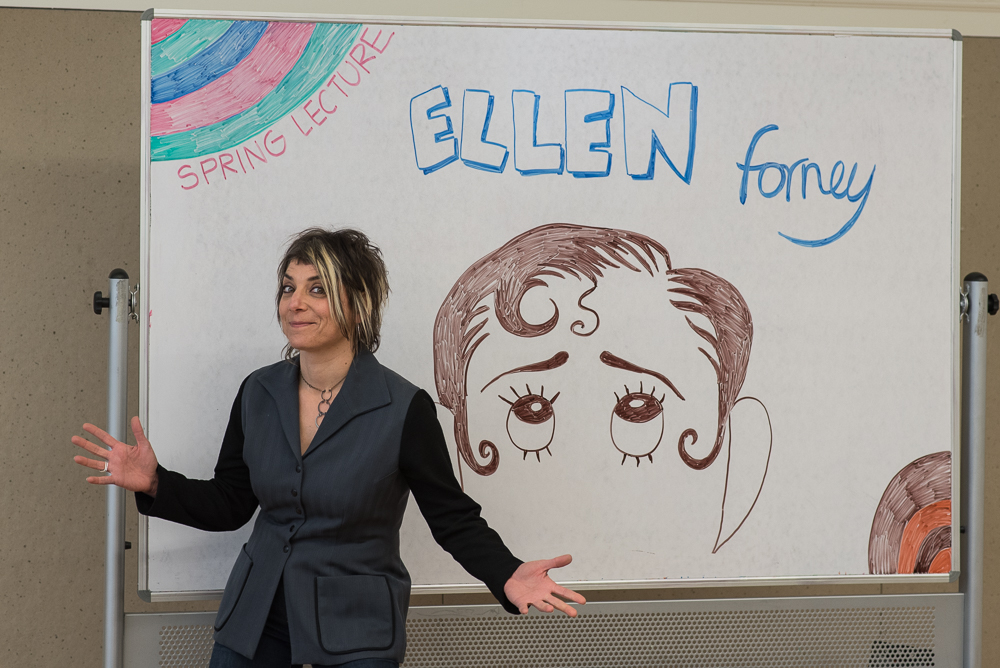
Ellen Forney with her visiting artist board by CCS’s Luke Howard
Ellen has been a cartoonist since 1992. She submitted her first work to The Stranger, an alt weekly newspaper in Seattle where CCS’s co-founder James Sturm was the editor. Twenty years later in 2012, she won the Stranger Genius Award. While she currently teaches comics at Cornish College of Arts, she rarely teaches other cartoonists and took the opportunity with CCS students to share her process.
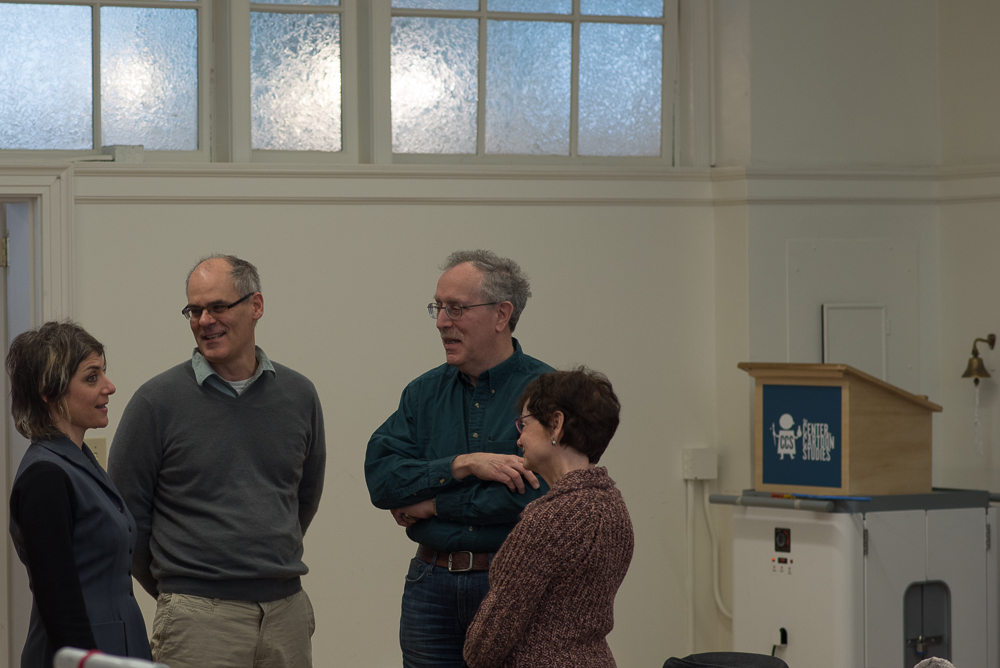
Ellen chatting with James Sturm, Nancy Carl Gropper from The Will and Ann Eisner foundation.
At her presentation CCS, Ellen gave students a virtual tour of her studio. A soup pot adjacent to her tall drafting desk and standing computer station helps keep her at the ideal height for work. Ellen uses an Epson large format scanner to scan her drawings. Her timeline for Marbles was too tight to scan pages in two parts necessitating the larger equipment; it’s a purchase that she has never regretted. Ellen also employs a full-length mirror and props to check poses as she works – “instant life drawing” as she calls it. One of these pops is a psychiatrist’s that she got for free off Craigslist while working on Marbles.
When inking, Ellen aims to use as few lines as possible for expression and volume. She uses Dr. Ph Martin Bombay ink with a kolinsky sable brush from Rosemary and Co: Series 33 Pure Kolinsky Sable Pointed and keeps her ink water in an old honey bear jar. She stores her brushes in a mustache mug – the kind of mug designed to keep a mustache dry. A rubber band around the handle holds her brushes tip down when they dry, which is important because it keeps the water out of the ferrule (the metal bit holding the hairs in). Ellen makes great use of tracing paper, especially for the last stage when she wants to try out hatching and solid blacks without ruining her line work.
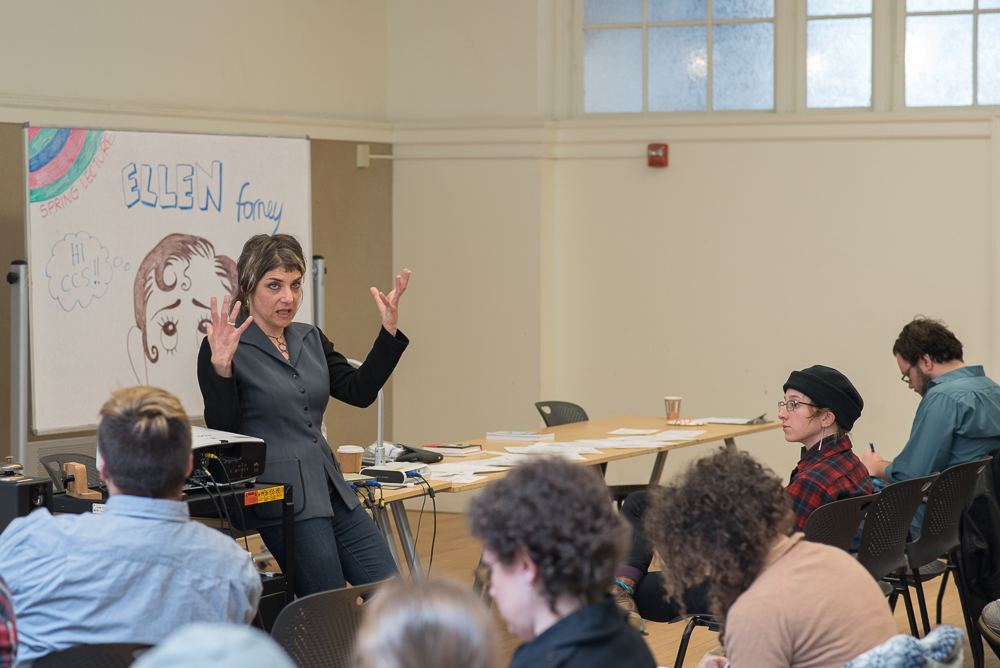
Ellen Forney speaking to the students at CCS
The process with Marbles taught Ellen a lot about editing; she quotes Scott McCloud, “amplification through simplification.” Her editor at Penguin was not a comics reader and gave her very useful edits for Marbles. For design feedback, she showed the work to cartoonists such as Megan Kelso, Jason Lutes, David Lasky, James Sturm, and others. They help with layout – where to use pictures instead of words. Ellen stressed that it is important to remember it is not a group decision. You can pick and choose the advice, even from people you really admire.
Ellen firmly believes in hand lettering because it adds to the intimacy and appeal of comics. Hand lettering shows the artist is in touch not just with the drawing, but with the text. A font, even made from your handwriting, flattens the text. As Ellen put it, even a good font is like seeing a pretty plant and realizing it is not real – you feel just a bit cheated.
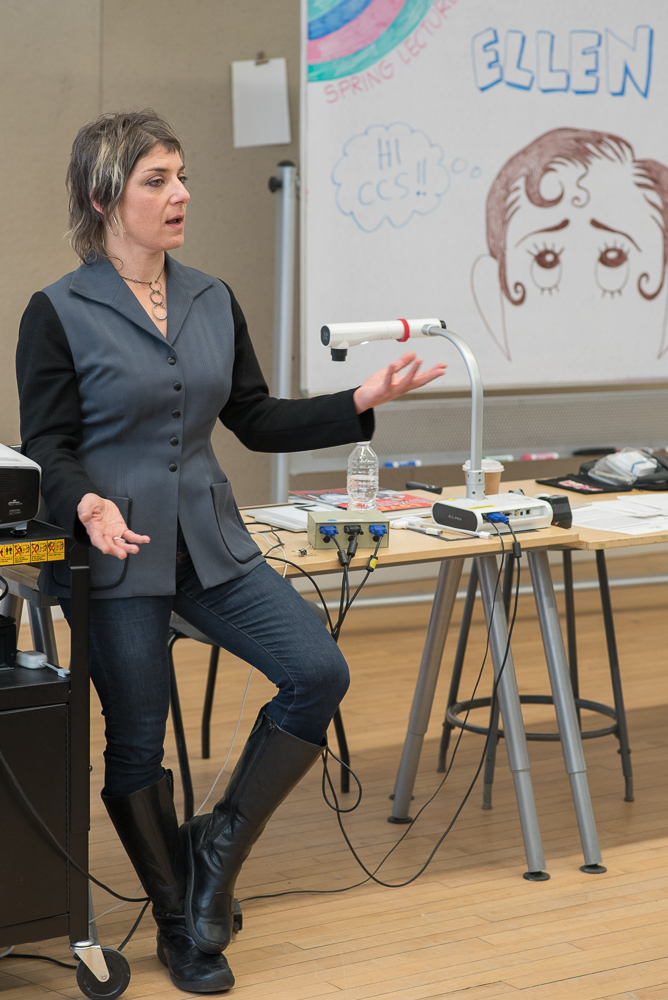
Ellen looking suave during her presentation at CCS.
One of the most amazing parts of Ellen’s talk at CCS was her presentation of I Love Led Zeppelin. For presenting a comic, she suggests that you don’t just do a slide show; remove the text bubbles, read the speech out loud instead, and add other elements like music. If you ever get a chance to see her perform I Love Led Zeppelin, and perform is really the right word, I highly recommend it. She pulled together all these elements and received a rousing round of applause.

Students after listening to Ellen talk at CCS
At Dartmouth, Ellen gave a more traditional presentation with a reading of the first two chapters of Marbles. She discussed what Marbles is about: struggle, coming to terms with bipolar disorder, what being a crazy artist means. Marbles is the biggest, most challenging project Ellen has ever done. Through this comic, she is seeking to give other people company and tools in their struggle. She recommends An Unquiet Mind by Kay Jamison and Darkness Visible by William Styron for other memoirs on bipolar disorder.
Ellen continues to work as an artist, and in a few years her art will be on display at light rail stations in Seattle. If you haven’t read Marbles yet, grab a copy of this poignant book from your local bookstore or come on down to the Schulz Library.
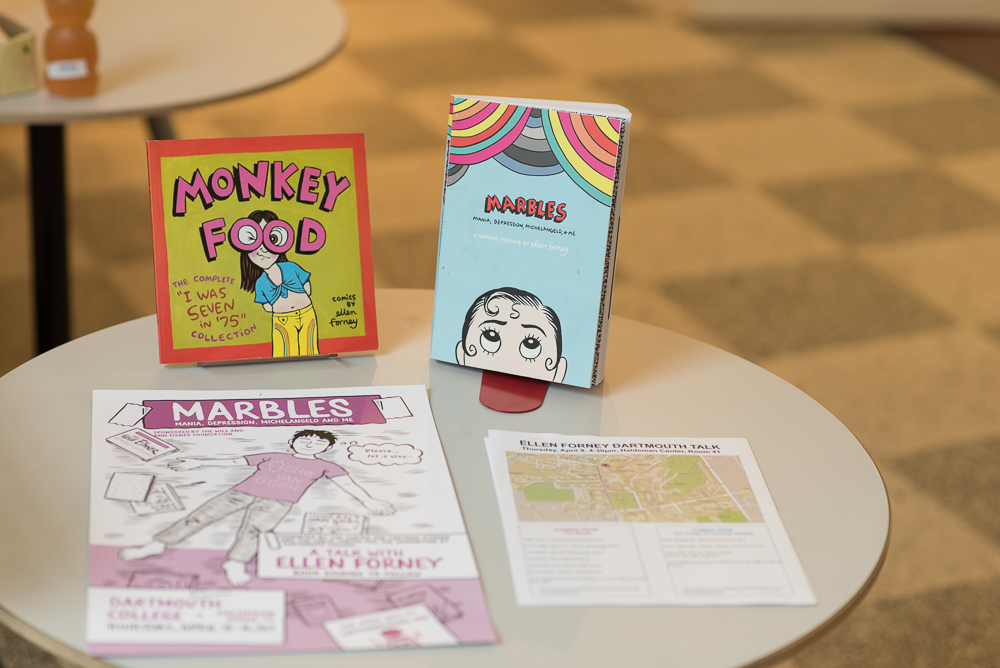
Ellen Forney’s books
Photos courtesy and copyright Abe Olson (abe@flyingdodostudio.com).

